
Pingali Venkayya
Pingali Venkayya was an Indian independence activist. Born August 2, 1876, in Bhatla Penumarru. Died July 4, 1963, in Vijayawada.
Facts
9 facts · 2 confirmed by two sources · 2 cited · 5 from one source
Where this comes from
Papalocal keeps its own record. It started from these sources; what each one said is kept here as it was copied, so a change on their side never changes this page by itself. Tap one to read its version.
What Wikidata says · copied November 18, 2026 · revision 2564403269
- Described as
- Indian independence activist (1876–1963)
- Other names
- Pingali Venkaiah
- Born
- August 2, 1876
- Died
- July 4, 1963
- Born in
- Bhatla Penumarru · 1 reference
- Died in
- Vijayawada · 1 reference
- Citizen of
- British Raj (–1947); Dominion of India (1947–1950); India (1950–)
- Occupation
- designer; writer · 1 reference
- Wikipedias with a page
- 22
Wikidata item Q1392116 (wikidata.org/wiki/Q1392116), public domain (CC0). Copied November 18, 2026.
What Wikipedia says · copied November 18, 2026 · revision 1385042380
Pingali Venkayya (2 August 1876/8 – 4 July 1963) was an Indian freedom fighter, known for designing the initial version of the Indian National Flag. Apart from his role in the independence movement, Venkayya was a lecturer, author, geologist, educationalist, agriculturist, and a polyglot.
Venkayya joined the British Indian Army at age 19 and served in South Africa during the Second Boer War (1899–1902). During his service, he recognized the need for a national flag for India as Indian soldiers were required to salute the Union Jack, the British flag. Inspired by his experience and later by attending the 1906 AICC session in Calcutta, he developed a vision for a flag representing Indians, opposing the practice of hoisting the British flag at Congress meetings.
Venkayya presented his design for an Indian national flag to Mahatma Gandhi in 1921 during Gandhi's visit to Vijayawada. The flag initially consisted of red and green stripes representing Hindus and Muslims, respectively, and, on Gandhi's suggestion, a white stripe was added to represent other communities in India. This flag design was used informally at Congress meetings from 1921 and served as the foundation for the Indian national flag, which was officially adopted in its final form by the Constituent Assembly on 22 July 1947.
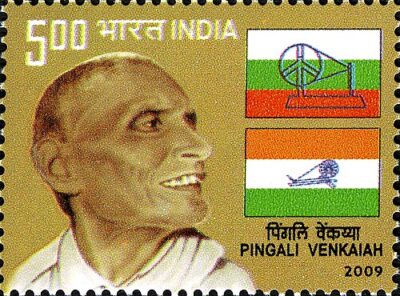
He retired from active politics in 1922. He was also an agriculturist, as well as an educationist who set up an educational institution in Machilipatnam. He died in 1963. In 2009, the Indian government issued a postage stamp in his honour, and in 2012, his name was recommended for a posthumous Bharat Ratna though no formal response was received from the central government.
- Born, in its opening lines
- August 2, 1876
- Died, in its opening lines
- July 4, 1963
From the Wikipedia article “Pingali Venkayya” (en.wikipedia.org/wiki/Pingali_Venkayya), by its contributors, under CC BY-SA 4.0 (creativecommons.org/licenses/by-sa/4.0/). Copied November 18, 2026; not changed.
Confirmed Two sources agree. Cited One source, and it names where it got it. One source One source, without a reference of its own. Sources disagree The sources disagree. We show the best-supported value and keep theirs below.
