
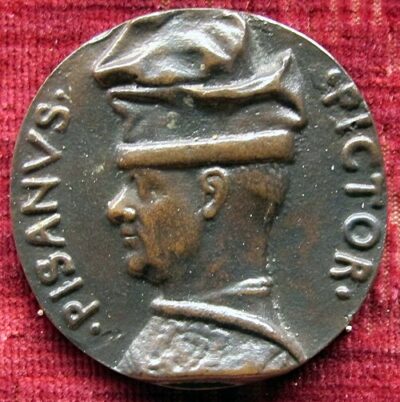
Pisanello
Pisanello was an Italian artist. Born 1395, in Pisa. Died 1455, in Rome. Known for Medal of John VIII Palaiologos, The Vision of Saint Eustace and Saint George and the Princess.
Facts
21 facts · 0 confirmed by two sources · 9 cited · 12 from one source
Where this comes from
Papalocal keeps its own record. It started from these sources; what each one said is kept here as it was copied, so a change on their side never changes this page by itself. Tap one to read its version.
What Wikidata says · copied November 16, 2026 · revision 2558217762
- Described as
- Italian artist (1395–1455)
- Other names
- Antonio di Puccio Pisano, Antonio di Puccio da Cereto, Antonio Pisano Pisanello, Antonio di Puccio Pisano Pisanello, Antonio Pisanello, Il Pisanello, Antonio Pisano, Vittore Pisano, Spisanello, Enea Pisano, V. Pisano
- Born
- 1395 · 19 references
- Died
- 1455 · 16 references
- Born in
- Pisa · 2 references
- Died in
- Rome · 1 reference
- Citizen of
- Republic of Pisa · 1 reference
- Occupation
- painter · 1 reference; illuminator · 1 reference; medalist · 2 references; draftsperson · 1 reference
- Genre
- portrait
- Known for
- Medal of John VIII Palaiologos; The Vision of Saint Eustace; Saint George and the Princess; Codex Vallardi · 1 reference; Drawings in the Codex Vallardi · 1 reference; First Lionello d'Este medal, Museo Correr · 1 reference; First Sigismondo Pandolfo Malatesta medal, Museo Correr · 1 reference; Niccolò Piccinino medal, Museo Correr · 1 reference; drawings for Saint George and the princess · 1 reference; Second Sigismondo Pandolfo Malatesta medal, Museo Correr · 1 reference
- Field
- painting · 1 reference
- Wikipedias with a page
- 44
Wikidata item Q311082 (wikidata.org/wiki/Q311082), public domain (CC0). Copied November 16, 2026.
What Wikipedia says · copied November 16, 2026 · revision 1370652796
Pisanello (c. 1380/1395 – c. 1450/1455), born Antonio di Puccio Pisano or Antonio di Puccio da Cereto, also erroneously called Vittore Pisano by Giorgio Vasari, was one of the most distinguished painters of the early Italian Renaissance and Quattrocento. He was acclaimed by poets such as Guarino da Verona and praised by humanists of his time, who compared him to such illustrious names as Cimabue, Phidias and Praxiteles.
Pisanello is known for his resplendent frescoes in murals, portraits, easel pictures, and a number of drawings such as those in the Codex Vallardi (Louvre). He is the most important commemorative portrait medallist in the first half of the 15th century, and he can claim to have originated this important genre.
He was employed by the Doge of Venice, the Pope in the Vatican and the courts of Verona, Ferrara, Mantua, Milan, Rimini, and by the King of Naples. He stood in high esteem in the Gonzaga and Este families.
Pisanello had a number of his works wrongly ascribed to other artists such as Piero della Francesca, Albrecht Dürer and Leonardo da Vinci, to name a few. While most of his paintings have perished, a number of his drawings and medals have survived.
From the Wikipedia article “Pisanello” (en.wikipedia.org/wiki/Pisanello), by its contributors, under CC BY-SA 4.0 (creativecommons.org/licenses/by-sa/4.0/). Copied November 16, 2026; not changed.
Confirmed Two sources agree. Cited One source, and it names where it got it. One source One source, without a reference of its own. Sources disagree The sources disagree. We show the best-supported value and keep theirs below.
