
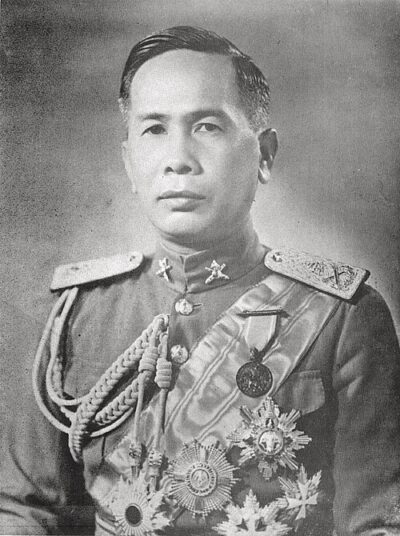
Plaek Phibunsongkhram
Plaek Phibunsongkhram was a Prime Minister of Thailand, 1938–44 and 1948–57. Born July 14, 1897, in Nonthaburi. Died June 11, 1964, in Sagamihara. Positions held include Prime Minister of Thailand (2 times) (1938–1957), Permanent Secretary for Defence of Thailand (1934) and Minister of Defence of Thailand (1952–1957). Educated at Chulachomklao Royal Military Academy. Awards include Order of the Nine Gems, Order of Chula Chom Klao and Order of the White Elephant.
Facts
34 facts · 2 confirmed by two sources · 1 cited · 31 from one source
Where this comes from
Papalocal keeps its own record. It started from these sources; what each one said is kept here as it was copied, so a change on their side never changes this page by itself. Tap one to read its version.
What Wikidata says · copied November 16, 2026 · revision 2562762180
- Described as
- Prime Minister of Thailand, 1938–44 and 1948–57 (1897–1964)
- Other names
- Phibul
- Born
- July 14, 1897 · 2 references
- Died
- June 11, 1964 · 2 references
- Born in
- Nonthaburi · 1 reference
- Died in
- Sagamihara
- Buried in
- Wat Phra Si Mahathat · 1 reference
- Citizen of
- Rattanakosin Kingdom (–1932); Thailand (1932–)
- Occupation
- politician; military personnel
- Positions held
- Prime Minister of Thailand (2 times) (1938–1957); Permanent Secretary for Defence of Thailand (1934) · 1 reference; Minister of Defence of Thailand (1952–1957) · 1 reference; Minister of Interior of Thailand (1955–1957) · 1 reference; Minister of Culture (1952–1955) · 1 reference; Minister of Commerce of Thailand (1954–1955) · 1 reference
- Political party
- Khana Ratsadon
- Education
- Chulachomklao Royal Military Academy
- Awards
- Order of the Nine Gems; Order of Chula Chom Klao; Order of the White Elephant; Order of the Crown of Thailand; Chief Commander of the Legion of Merit; Order of the Rising Sun, 1st class; Order of Sikatuna; Grand Cross 1st class of the Order of Merit of the Federal Republic of Germany; Order of the Paulownia Flowers · 1 reference; Order of the German Eagle · 1 reference; Grand Cross of Naval Merit with white badge (1955) · 1 reference
- Spouse
- La-iat Phibunsongkhram (1916–1964)
- Children
- Nitya Pibulsonggram
- Religion
- Theravāda; Buddhism
- Military branch
- Royal Thai Army · 1 reference
- Military rank
- field marshal
- Wikipedias with a page
- 52
Wikidata item Q152777 (wikidata.org/wiki/Q152777), public domain (CC0). Copied November 16, 2026.
What Wikipedia says · copied November 16, 2026 · revision 1385849410
Plaek Phibunsongkhram (14 July 1897 – 11 June 1964), commonly known in English language sources as Phibun and as Chomphon Por in Thai, was a Thai military officer and politician who served as the third prime minister of Thailand from 1938 to 1944 and again from 1948 to 1957. He rose to power as a leading member of the Khana Ratsadon, becoming prime minister in 1938 and later consolidating his influence as a military dictator. His regime allied with the Empire of Japan during World War II, and his administration was marked by authoritarian policies and the promotion of Thai nationalism. He was closely involved in both domestic reforms and foreign policy during the war and played a central role in shaping modern Thai state ideology. Phibun's ideology has been described as fascist.
Born in Nonthaburi, Phibun graduated from the Royal Military Academy in 1914 before continuing his studies in France. After returning to Siam, he became involved in the Khana Ratsadon, a group that led the 1932 Siamese Revolution, which replaced the country's absolute monarchy with a constitutional monarchy. Phibun emerged as a prominent military figure following the revolution, gradually consolidating power within the armed forces.
In 1938, Phibun became prime minister while serving as Commander of the Royal Siamese Army. Inspired by the Italian leader Benito Mussolini, his government established an authoritarian regime run along fascist lines, and launched a series of cultural mandates aimed at modernizing Thai society. These policies included changing the country's name from "Siam" to "Thailand", promoting Western-style dress, emphasizing the Thai language, and encouraging Thai nationalism and Sinophobia. During World War II, Phibun aligned Thailand with Imperial Japan, allowing Japanese forces to pass through Thai territory and later declaring war on the Allies. This alliance was controversial and led to internal resistance, most notably the Free Thai Movement and Regent Pridi Banomyong, a former associate within the Khana Ratsadon. As the war progressed and Japan's position weakened, Phibun lost political support and was forced to resign by the National Assembly in 1944. Following the war, he faced accusations of war crimes, though he was later acquitted.
Phibun returned to power in 1948 through a military-backed coup and ruled during the early Cold War period. His second premiership adopted a strongly anti-communist stance and aligned Thailand closely with the United States. Despite economic development and continued modernization efforts, his government was plagued by political instability and several attempts to launch a coup against him were made, including the Army General Staff plot (1948), the Palace Rebellion (1949), and the Manhattan Rebellion (1951). Phibun attempted to transform Thailand into an electoral democracy from the mid-1950s onward, but he was overthrown by his subordinate Sarit Thanarat during a coup in 1957 and went into exile in Japan until his death in 1964. His legacy remains contested, as he is viewed both as a modernizer and as a symbol of military authoritarianism in Thai political history.
- Born, in its opening lines
- July 14, 1897
- Died, in its opening lines
- June 11, 1964
From the Wikipedia article “Plaek Phibunsongkhram” (en.wikipedia.org/wiki/Plaek_Phibunsongkhram), by its contributors, under CC BY-SA 4.0 (creativecommons.org/licenses/by-sa/4.0/). Copied November 16, 2026; not changed.
Confirmed Two sources agree. Cited One source, and it names where it got it. One source One source, without a reference of its own. Sources disagree The sources disagree. We show the best-supported value and keep theirs below.
