
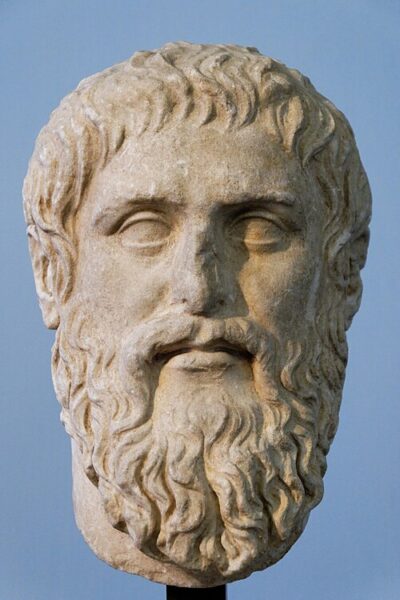
Plato
Plato was the 4th-century BCE Greek philosopher. Born 420s BC, in Athens. Died 340s BC, in Athens. Positions held include scholarch of the Platonic Academy (-387–-347). Known for Crito, Euthyphro and Phaedo.
Facts
37 facts · 0 confirmed by two sources · 10 cited · 25 from one source · 2 where the sources disagree
What’s different
- Born: we show 420s BC (Sources disagree). Wikipedia says 428
- Died: we show 340s BC (Sources disagree). Wikipedia says 347
Where this comes from
Papalocal keeps its own record. It started from these sources; what each one said is kept here as it was copied, so a change on their side never changes this page by itself. Tap one to read its version.
What Wikidata says · copied November 16, 2026 · revision 2568739855
- Described as
- 4th-century BCE Greek philosopher
- Other names
- Αριστοκλής, Platon, Aristocles, Plátōn, Ἀριστοκλῆς
- Born
- 420s BC · 3 references
- Died
- 340s BC · 2 references
- Born in
- Athens · 2 references
- Died in
- Athens · 1 reference
- Buried in
- Tomb of Plato, Athens
- Name at birth
- Ἀριστοκλῆς
- Citizen of
- Classical Athens · 1 reference
- Occupation
- philosopher · 2 references; epigrammatist; poet; writer · 1 reference; philosopher of law
- Positions held
- scholarch of the Platonic Academy (-387–-347)
- Sport
- Greek wrestling
- Genre
- Platonic dialogue
- Known for
- Crito; Euthyphro; Phaedo; Euthydemus; Protagoras; Timaeus; Gorgias; Meno; Apology; Charmides
- Field
- philosophy · 1 reference; literature · 1 reference; epistemology · 1 reference; law · 1 reference; politics · 1 reference; education · 1 reference
- Father
- Ariston of Athens · 2 references
- Mother
- Perictione · 1 reference
- Siblings
- Potone; Adeimantus of Collytus; Glaucon · 1 reference; Antiphon · 1 reference
- Wikipedias with a page
- 304
Wikidata item Q859 (wikidata.org/wiki/Q859), public domain (CC0). Copied November 16, 2026.
What Wikipedia says · copied November 16, 2026 · revision 1380641527
Plato ( PLAY-toh; Ancient Greek: Πλάτων, Plátōn; c. 428–347 BC) was an ancient Greek philosopher of Classical Athens who is most commonly considered the foundational thinker of the Western philosophical tradition. An innovator of the literary dialogue and dialectic forms, Plato influenced all the major areas of theoretical philosophy and practical philosophy, and was the founder of the Academy, a philosophical school in Athens where Plato taught the collection of philosophical theories that would later become known as Platonism.
Plato's most famous contribution is his Theory of Forms (or Ideas), which aims to solve what is now known as the problem of universals. He was influenced by the pre-Socratic thinkers Pythagoras, Heraclitus, and Parmenides, although much of what is known about them is derived from Plato himself.
Along with his teacher Socrates, and his student Aristotle, Plato is a central figure in the history of Western philosophy. 2,400 years later, Plato's complete works are believed to have survived—unlike those of nearly all of his contemporaries. Although their popularity has fluctuated, they have consistently been read and studied through the ages. Through Platonism's outgrowth Neoplatonism, he also influenced Christian, Jewish and Islamic philosophy. In modern times, Alfred North Whitehead said: "the safest general characterization of the European philosophical tradition is that it consists of a series of footnotes to Plato."
- Born, in its opening lines
- 428
- Died, in its opening lines
- 347
From the Wikipedia article “Plato” (en.wikipedia.org/wiki/Plato), by its contributors, under CC BY-SA 4.0 (creativecommons.org/licenses/by-sa/4.0/). Copied November 16, 2026; not changed.
Confirmed Two sources agree. Cited One source, and it names where it got it. One source One source, without a reference of its own. Sources disagree The sources disagree. We show the best-supported value and keep theirs below.
