
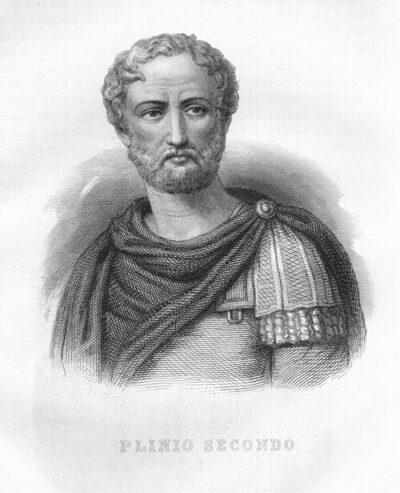
Pliny the Elder
Pliny the Elder was a Roman military commander and writer (AD23/24–79). Born 20s, in Novum Comum. Died 79, in Stabiae. Positions held include procurator Narbonensis (70–72) and praefectus classis Misenensis (79). Known for Natural History.
Facts
24 facts · 0 confirmed by two sources · 11 cited · 13 from one source
Where this comes from
Papalocal keeps its own record. It started from these sources; what each one said is kept here as it was copied, so a change on their side never changes this page by itself. Tap one to read its version.
What Wikidata says · copied November 16, 2026 · revision 2568444803
- Described as
- Roman military commander and writer (AD23/24–79)
- Other names
- Caius Plinius Secundus, the Elder Pliny, Caius P. Secundus, Pliny, C. Plinius Secundus, Gaius P. Secundus, Plinius, Gaius Plinius Secundus
- Born
- 20s · 6 references
- Died
- 79 · 7 references
- Born in
- Novum Comum · 9 references
- Died in
- Stabiae · 9 references
- Cause of death
- volcanic eruption
- Citizen of
- Ancient Rome · 1 reference
- Occupation
- writer · 2 references; historian · 1 reference; naturalist · 1 reference; poet · 1 reference; philosopher · 1 reference; art historian · 2 references; civil servant · 1 reference; military commander · 1 reference
- Positions held
- procurator Narbonensis (70–72); praefectus classis Misenensis (79) · 1 reference
- Known for
- Natural History
- Field
- philosophy; natural science; geography
- Children
- Pliny the Younger
- Father
- Gaius Plinius Celer
- Mother
- Marcella
- Siblings
- Plinia Marcella
- Wikipedias with a page
- 127
Wikidata item Q82778 (wikidata.org/wiki/Q82778), public domain (CC0). Copied November 16, 2026.
What Wikipedia says · copied November 16, 2026 · revision 1385934867
Gaius Plinius Secundus (23 or 24 – 25 August 79), known in English as Pliny the Elder ( PLIN-ee), was a Roman author, naturalist, scientist, naval and army commander of the early Roman Empire, procurator, and friend of Emperor Vespasian. Pliny wrote the encyclopedic Naturalis Historia (Natural History), a thirty-seven-volume work covering a vast array of topics on human knowledge and the natural world, which became an editorial model for encyclopedias. He spent most of his spare time studying, writing, and investigating natural and geographic phenomena in the field.
Pliny produced seven works spanning 102 volumes, of which only Natural History survives. Among the lost works was the twenty-volume Bella Germaniae (Wars of Germania), used as a source by other prominent Roman historians including Plutarch, Tacitus, and Suetonius. Tacitus may have used Bella Germaniae as the primary source for his work, De origine et situ Germanorum (On the Origin and Situation of the Germani). Also substantial was the thirty-one-volume history A fine Aufidii Bassi, which extended Aufidius Bassus' earlier historical work to Pliny's day.
Pliny the Elder died in AD 79 in Stabiae while attempting to rescue people from the eruption of Mount Vesuvius. In his will, Pliny the Elder posthumously adopted his nephew Gaius Plinius Caecilius Secundus, who is known to history as Pliny the Younger.
From the Wikipedia article “Pliny the Elder” (en.wikipedia.org/wiki/Pliny_the_Elder), by its contributors, under CC BY-SA 4.0 (creativecommons.org/licenses/by-sa/4.0/). Copied November 16, 2026; not changed.
Confirmed Two sources agree. Cited One source, and it names where it got it. One source One source, without a reference of its own. Sources disagree The sources disagree. We show the best-supported value and keep theirs below.
