
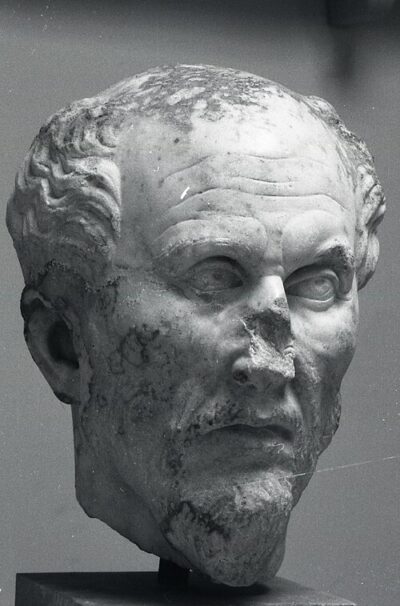
Plotinus
Plotinus was a Hellenistic Platonist philosopher and founder of Neoplatonism (c. 204/5–270). Born 205, in Asyut. Died 270, in Minturno. Known for Enneads.
Facts
9 facts · 0 confirmed by two sources · 4 cited · 4 from one source · 1 where the sources disagree
What’s different
- Born in: we show Asyut (Sources disagree). Wikidata also lists Lycopolis
Where this comes from
Papalocal keeps its own record. It started from these sources; what each one said is kept here as it was copied, so a change on their side never changes this page by itself. Tap one to read its version.
What Wikidata says · copied November 16, 2026 · revision 2567489772
- Described as
- Hellenistic Platonist philosopher and founder of Neoplatonism (c. 204/5–270)
- Other names
- Plotinos
- Born
- 205 · 1 reference
- Died
- 270 · 11 references
- Born in
- Lycopolis; Asyut · 1 reference
- Died in
- Minturno
- Citizen of
- Ancient Rome
- Occupation
- philosopher · 1 reference; writer · 1 reference
- Known for
- Enneads
- Field
- philosophy
- Wikipedias with a page
- 104
Wikidata item Q134189 (wikidata.org/wiki/Q134189), public domain (CC0). Copied November 16, 2026.
What Wikipedia says · copied November 16, 2026 · revision 1385635705
Plotinus (; Ancient Greek: Πλωτῖνος, Plōtînos; c. 204/5 – 270 AD) was an ancient Greek philosopher, born and raised in Roman Egypt. He is widely regarded by modern scholars as the founder of Neoplatonism.
Plotinus was a student of the self-taught philosopher Ammonius Saccas, who belonged to the Platonic tradition. Historians in the 19th century coined the term "Neoplatonism" to describe Plotinus and his philosophy. This philosophical tradition was vastly influential during late antiquity, the Middle Ages, and the Renaissance.
In his metaphysical writings, Plotinus described three fundamental principles: the One, the Intellect, and the Soul. His works have inspired generations of pagan, Jewish, Christian, Gnostic, and early Islamic metaphysicians and mystics. His ideas shaped metaphysical works, particularly his work on duality of the One. These ideas later influenced several mainstream theological concepts within different religions.
From the Wikipedia article “Plotinus” (en.wikipedia.org/wiki/Plotinus), by its contributors, under CC BY-SA 4.0 (creativecommons.org/licenses/by-sa/4.0/). Copied November 16, 2026; not changed.
Confirmed Two sources agree. Cited One source, and it names where it got it. One source One source, without a reference of its own. Sources disagree The sources disagree. We show the best-supported value and keep theirs below.
