
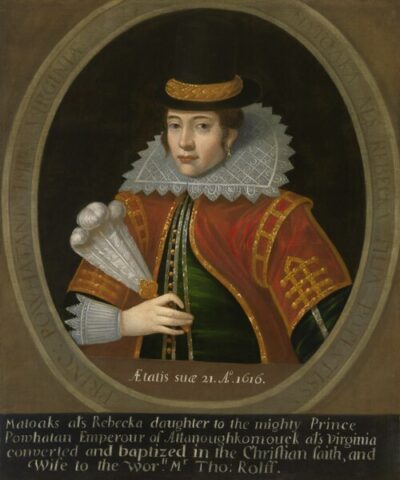
Pocahontas was an American native woman. Born 1596, in Werowocomoco. Died March 21, 1617, in Gravesend.
Facts
18 facts · 2 confirmed by two sources · 5 cited · 11 from one source
Where this comes from
Papalocal keeps its own record. It started from these sources; what each one said is kept here as it was copied, so a change on their side never changes this page by itself. Tap one to read its version.
What Wikidata says · copied November 16, 2026 · revision 2567193566
- Described as
- American native woman
- Other names
- Rebecca Rolfe, Amonute, Matoaka, Matoax
- Born
- 1596 · 2 references
- Died
- March 21, 1617 · 1 reference
- Born in
- Werowocomoco
- Died in
- Gravesend · 2 references
- Buried in
- St George's Church, Gravesend
- Name at birth
- Amonute
- Citizen of
- Tsenacommacah; Kingdom of England
- Occupation
- writer
- Spouse
- John Rolfe (1614–1617) · 1 reference; Kocoum (1610–1613) · 1 reference
- Children
- Thomas Rolfe · 1 reference; Ka-Okee Powhatan
- Father
- Chief Powhatan · 1 reference
- Mother
- Nonoma Winanuske Matatiske
- Siblings
- Nantequaus; Cleopatra Powhatan
- Religion
- Anglicanism (1613–)
- Wikipedias with a page
- 65
Wikidata item Q193406 (wikidata.org/wiki/Q193406), public domain (CC0). Copied November 16, 2026.
What Wikipedia says · copied November 16, 2026 · revision 1378909528
Pocahontas (US: , UK: ; born Amonute, also known as Matoaka and Rebecca Rolfe; c. 1596 – March 1617) was a Native American woman belonging to the Powhatan people, notable for her association with the colonial settlement at Jamestown, Virginia. She was the daughter of Wahunsenacawh, the Mamanatowick (leader) of a network of tributary tribes in the Powhatan Confederacy, encompassing the Tidewater region of what is today the U.S. state of Virginia.
Pocahontas was captured and held for ransom by English colonists during hostilities in 1613. During her captivity, she was encouraged to convert to Christianity and was baptized under the name Rebecca. She married the tobacco planter John Rolfe in April 1614 at the age of about 17 or 18, and she bore their son, Thomas Rolfe, in January 1615.
In 1616, the Rolfes travelled to London, where Pocahontas was presented to English society as an example of the "civilized savage" in hopes of stimulating investment in Jamestown. On this trip, she may have met Squanto, a Patuxet man from New England. Pocahontas became a celebrity, was elegantly fêted, and attended a masque at Whitehall Palace. In 1617, the Rolfes intended to sail for Virginia, but Pocahontas died at Gravesend, Kent, England, of unknown causes, aged 20 or 21. She was buried in St George's Church, Gravesend; her grave's exact location is unknown because the church was rebuilt after being destroyed by a fire.
Numerous places, landmarks, and products in the United States have been named after Pocahontas. Her story has been romanticized over the years, many aspects of which are fictional. Many of the stories told about her by the English explorer John Smith have been contested by her documented descendants. She is a subject of art, literature, and film. Many famous people have claimed to be among her descendants, including members of the First Families of Virginia, First Lady Edith Wilson, American actor Glenn Strange, and astronomer Percival Lowell.
- Born, in its opening lines
- c. 1596
- Died, in its opening lines
- March 1617
From the Wikipedia article “Pocahontas” (en.wikipedia.org/wiki/Pocahontas), by its contributors, under CC BY-SA 4.0 (creativecommons.org/licenses/by-sa/4.0/). Copied November 16, 2026; not changed.
Confirmed Two sources agree. Cited One source, and it names where it got it. One source One source, without a reference of its own. Sources disagree The sources disagree. We show the best-supported value and keep theirs below.
