
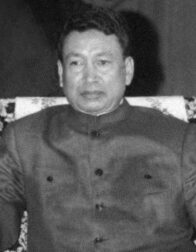
Pol Pot
Pol Pot was a former General Secretary of the Communist Party of Kampuchea. Born May 19, 1925, in Prek Sbauv. Died April 15, 1998, in Anlong Veng District. Positions held include General Secretary of the Communist Party of Kampuchea (1963–1981) and Prime Minister of Cambodia (1976–1979). Educated at EFREI and Lycee Sisowath. Awards include Hero of the Republic and Order of the National Flag.
Facts
27 facts · 2 confirmed by two sources · 4 cited · 21 from one source
Where this comes from
Papalocal keeps its own record. It started from these sources; what each one said is kept here as it was copied, so a change on their side never changes this page by itself. Tap one to read its version.
What Wikidata says · copied November 16, 2026 · revision 2564486331
- Described as
- former General Secretary of the Communist Party of Kampuchea (1925–1998)
- Other names
- Saloth Sar, Brother Number One
- Born
- May 19, 1925 · 8 references
- Died
- April 15, 1998 · 5 references
- Born in
- Prek Sbauv · 1 reference
- Died in
- Anlong Veng District · 1 reference
- Buried in
- Anlong Veng District · 1 reference
- Name at birth
- សាឡុត ស
- Citizen of
- French Indochina; Kingdom of Cambodia; Khmer Republic; Democratic Kampuchea
- Occupation
- politician · 1 reference; military officer
- Positions held
- General Secretary of the Communist Party of Kampuchea (1963–1981); Prime Minister of Cambodia (1976–1979)
- Political party
- Communist Party of Kampuchea; Party of Democratic Kampuchea; Cambodian National Unity Party
- Education
- EFREI; Lycee Sisowath
- Awards
- Hero of the Republic; Order of the National Flag
- Spouse
- Khieu Ponnary
- Father
- Saloth Phem
- Siblings
- Saloth Chhay; Loth Suong
- Religion
- atheism
- Military rank
- general
- Wikipedias with a page
- 132
Wikidata item Q39464 (wikidata.org/wiki/Q39464), public domain (CC0). Copied November 16, 2026.
What Wikipedia says · copied November 16, 2026 · revision 1385868058
Pol Pot (born Saloth Sâr; 19 May 1925 – 15 April 1998) was a Cambodian politician, revolutionary, and dictator who ruled Democratic Kampuchea from 1975 until his overthrow in 1979 during the Cambodian–Vietnamese War. Ideologically a Maoist and Khmer ethnonationalist, Pot led Cambodia's Communist movement, known as the Khmer Rouge, which seized power in 1975 and established a one-party state under the Communist Party of Kampuchea. Over the next four years, the Khmer Rouge perpetrated the Cambodian genocide, in which an estimated 1.5–2 million people died—approximately one-quarter of the country's pre-genocide population. In December 1978, Vietnam invaded Cambodia to remove the Khmer Rouge from power, ending the genocide and establishing a new Cambodian government, with the Khmer Rouge restricted to the rural hinterlands in the western part of the country. He is widely believed to be one of the most brutal despots in modern world history.
Born to a prosperous farmer in Prek Sbauv, French Cambodia, Pol Pot was educated at some of Cambodia's most elite schools. Arriving in Paris in October 1949 on an academic scholarship, he later joined the French Communist Party in 1951 while studying at the École française de radioélectricité. Returning to Cambodia in 1953, he involved himself in the Khmer Viet Minh organisation and its guerrilla war against King Norodom Sihanouk's newly independent government. Following the Khmer Viet Minh's 1954 retreat into North Vietnam, Pol Pot returned to Phnom Penh, working as a teacher while remaining a central member of Cambodia's Marxist–Leninist movement. In 1959, he helped formalise the movement into the Kampuchean Labour Party, which was later renamed the Communist Party of Kampuchea (CPK). To avoid state repression, in 1962 he relocated to a jungle encampment and in 1963 he became the CPK's leader. In 1968, he relaunched the war against Sihanouk's government. After Lon Nol ousted Sihanouk in a 1970 coup, Pol Pot's forces sided with the deposed leader against the new government, which was bolstered by the United States military. Aided by the Viet Cong militia and North Vietnamese troops, Khmer Rouge forces advanced and controlled all of Cambodia by 1975.
Pol Pot transformed Cambodia into a one-party state that he called Democratic Kampuchea, seeking to create an agrarian socialist society that he believed would evolve into a communist one. Year Zero was an idea put into practice by Pol Pot where he believed that all cultures and traditions must be completely destroyed and a new revolutionary culture must replace it starting from scratch. "Year Zero" was announced by the Khmer Rouge on April 17, 1975, where everything before that date must be purged. The Khmer Rouge emptied the cities, frogmarched Cambodians to labor camps and relocated the urban population to collective farms, where mass executions, abuse, torture, malnutrition and disease were rampant. In the Killing Fields, more than 1.3 million people were executed and buried in mass graves. Pursuing complete egalitarianism, money, religion, and private property were abolished and all citizens were forced to wear the same black clothing. Repeated purges of the CPK generated growing discontent; by 1978, Cambodian soldiers were mounting a rebellion in the east.
After several years of Khmer Rouge incursions and massacres on Vietnamese territory, Vietnam invaded Cambodia in December 1978. By January 1979, Pot and the Khmer Rouge had been toppled. The surviving Khmer Rouge members retreated to the scattered jungles near the Thai border, from where they continued to fight and raid. Severely weakened, they were hunted down by Vietnamese soldiers until their withdrawal in 1989. In declining health, Pol Pot stepped back from many of his roles in the movement. In 1998, the Khmer Rouge commander Ta Mok placed Pot under house arrest. Pol Pot died shortly afterward.
China and later the United States supported his movement as a bulwark against Soviet influence in Southeast Asia during the Sino-Soviet split. Regarded as a totalitarian dictator guilty of crimes against humanity, he has been widely denounced internationally for his role in the Cambodian genocide.
- Born, in its opening lines
- May 19, 1925
- Died, in its opening lines
- April 15, 1998
From the Wikipedia article “Pol Pot” (en.wikipedia.org/wiki/Pol_Pot), by its contributors, under CC BY-SA 4.0 (creativecommons.org/licenses/by-sa/4.0/). Copied November 16, 2026; not changed.
Confirmed Two sources agree. Cited One source, and it names where it got it. One source One source, without a reference of its own. Sources disagree The sources disagree. We show the best-supported value and keep theirs below.
