
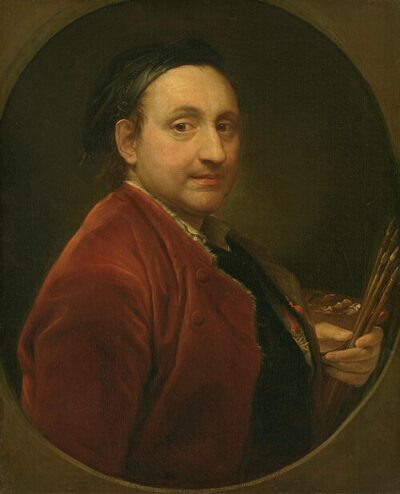
Pompeo Batoni
Pompeo Batoni was an Italian painter. Born January 25, 1708, in Lucca. Died February 4, 1787, in Rome. Known for Truth and Mercy, Peace and Justice and Charles Joseph Crowle.
Facts
13 facts · 2 confirmed by two sources · 5 cited · 6 from one source
Where this comes from
Papalocal keeps its own record. It started from these sources; what each one said is kept here as it was copied, so a change on their side never changes this page by itself. Tap one to read its version.
What Wikidata says · copied November 16, 2026 · revision 2564802373
- Described as
- Italian painter (1708-1787)
- Born
- January 25, 1708 · 14 references
- Died
- February 4, 1787 · 13 references
- Born in
- Lucca · 2 references
- Died in
- Rome · 1 reference
- Cause of death
- stroke · 1 reference
- Name at birth
- Pompeo Girolamo Battoni · 2 references
- Occupation
- painter · 3 references
- Member of
- Accademia delle Arti del Disegno
- Genre
- portrait
- Known for
- Truth and Mercy; Peace and Justice; Charles Joseph Crowle; The Ecstasy of St Catherine · 1 reference
- Wikipedias with a page
- 34
Wikidata item Q505613 (wikidata.org/wiki/Q505613), public domain (CC0). Copied November 16, 2026.
What Wikipedia says · copied November 16, 2026 · revision 1380910120
Pompeo Girolamo Batoni (25 January 1708 – 4 February 1787) was an Italian painter who displayed a solid technical knowledge in his portrait work and in his numerous allegorical and mythological pictures. The high number of foreign visitors travelling throughout Italy and reaching Rome during their "Grand Tour" led the artist to specialise in portraits.
Batoni won international fame largely thanks to his customers, mostly British and Anglo-Irish gentlemen, whom he portrayed, often with famous Italian landscapes in the background. Such Grand Tour portraits by Batoni were in British private collections, thus ensuring the genre's popularity in Great Britain. One generation later, Sir Joshua Reynolds would take up this tradition and become the leading English portrait painter. Although Batoni was considered the best Italian painter of his time, contemporary chronicles mention his rivalry with Anton Raphael Mengs.
In addition to art-loving nobility, Batoni's subjects included the kings and queens of Poland, Portugal, and Prussia; the Holy Roman Emperors Joseph II and Leopold II (a fact which earned him noble dignity); the popes Benedict XIV, Clement XIII, and Pius VI, Elector Karl Theodor of Bavaria; and many more. He also received numerous commissions for altarpieces for churches (in Rome, Brescia, Lucca and Parma, for example) as well as for mythological and allegorical subjects.
Batoni's style took inspiration and incorporated elements of classical antiquity, French Rococo, Bolognese classicism, and the work of artists such as Nicolas Poussin, Claude Lorrain, and especially Raphael. As such, Pompeo Batoni is considered a precursor of Neoclassicism.
- Born, in its opening lines
- January 25, 1708
- Died, in its opening lines
- February 4, 1787
From the Wikipedia article “Pompeo Batoni” (en.wikipedia.org/wiki/Pompeo_Batoni), by its contributors, under CC BY-SA 4.0 (creativecommons.org/licenses/by-sa/4.0/). Copied November 16, 2026; not changed.
Confirmed Two sources agree. Cited One source, and it names where it got it. One source One source, without a reference of its own. Sources disagree The sources disagree. We show the best-supported value and keep theirs below.
