
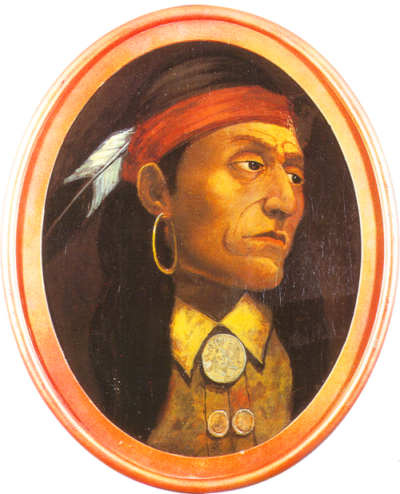
Pontiac
Pontiac was an Ottawa Indian leader. Born 1720, in Great Lakes region. Died April 20, 1769, in Cahokia. Positions held include war chief.
Facts
9 facts · 0 confirmed by two sources · 3 cited · 6 from one source
Where this comes from
Papalocal keeps its own record. It started from these sources; what each one said is kept here as it was copied, so a change on their side never changes this page by itself. Tap one to read its version.
What Wikidata says · copied November 16, 2026 · revision 2567362328
- Described as
- Ottawa Indian leader (1720-1769)
- Other names
- Pondiac, Obwandiyag
- Born
- 1720
- Died
- April 20, 1769 · 5 references
- Born in
- Great Lakes region
- Died in
- Cahokia · 1 reference
- Occupation
- politician; traditional leader or chief · 1 reference; war chief
- Positions held
- war chief
- Member of
- Odawa
- Wikipedias with a page
- 35
Wikidata item Q314960 (wikidata.org/wiki/Q314960), public domain (CC0). Copied November 16, 2026.
What Wikipedia says · copied November 16, 2026 · revision 1378045503
Pontiac or Obwaandi'eyaag (c. 1714/20 – April 20, 1769) was an Odawa war chief known for his role in the war named for him, from 1763 to 1766 leading Native Americans in an armed struggle against the British in the Great Lakes region due to, among other reasons, dissatisfaction with British policies. It followed the British victory in the French and Indian War, the North American front of the Seven Years' War. Pontiac's importance in the war that bears his name has been debated. Historical accounts from the 19th century portrayed him as the mastermind and leader of the revolt, but some subsequent scholars argued that his role had been exaggerated. Historians today generally view him as an important local leader who influenced a wider movement that he did not command.
The war began in May 1763 when Pontiac and 300 followers attempted to take Fort Detroit by surprise. His plan foiled, Pontiac laid siege to the fort, where he was eventually joined by more than 900 warriors from a half-dozen tribes. Meanwhile, messengers spread the word of Pontiac's actions, and the war expanded far beyond Detroit. In July 1763, Pontiac defeated a British detachment at the Battle of Bloody Run, but he was unable to capture the fort. In October, he lifted the siege and withdrew to the Illinois Country. Pontiac's actions contributed to the British Crown's issuance of the Proclamation of 1763, which prohibited new settlements west of the Appalachian Mountains to preserve the area for Native Americans.
Pontiac's influence declined around Detroit because of the siege but he gained stature as he continued to encourage the various tribal leaders to fight against the British. Seeking to end the war, British officials made him the focus of their diplomatic efforts. In July 1766, he made peace with British Superintendent of Indian Affairs Sir William Johnson. The British attention to Pontiac aroused resentment among other tribal leaders, as the war effort was decentralized while Pontiac claimed greater authority than he possessed. He was increasingly ostracized and in 1769 he was assassinated by a Peoria warrior.
From the Wikipedia article “Pontiac (Odawa leader)” (en.wikipedia.org/wiki/Pontiac_(Odawa_leader)), by its contributors, under CC BY-SA 4.0 (creativecommons.org/licenses/by-sa/4.0/). Copied November 16, 2026; not changed.
Confirmed Two sources agree. Cited One source, and it names where it got it. One source One source, without a reference of its own. Sources disagree The sources disagree. We show the best-supported value and keep theirs below.
