
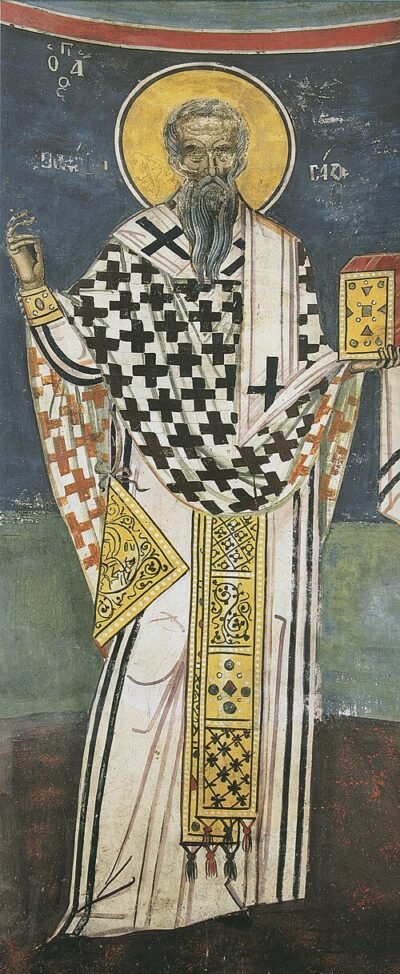
Porphyry of Gaza was a bishop of Gaza and Byzantine saint. Born 347, in Thessaloniki. Died February 26, 420, in Gaza City. Positions held include bishop (395–420).
Facts
7 facts · 2 confirmed by two sources · 1 cited · 4 from one source
Where this comes from
Papalocal keeps its own record. It started from these sources; what each one said is kept here as it was copied, so a change on their side never changes this page by itself. Tap one to read its version.
What Wikidata says · copied November 17, 2026 · revision 2554599622
- Described as
- bishop of Gaza and Byzantine saint
- Other names
- Porphyrius Gazaeus, Porphyrios Gazaios
- Born
- 347 · 1 reference
- Died
- February 26, 420 · 1 reference
- Born in
- Thessaloniki
- Died in
- Gaza City
- Occupation
- Catholic priest
- Positions held
- bishop (395–420) · 1 reference
- Religion
- Catholicism
- Wikipedias with a page
- 27
Wikidata item Q1283669 (wikidata.org/wiki/Q1283669), public domain (CC0). Copied November 17, 2026.
What Wikipedia says · copied November 17, 2026 · revision 1369327141
Porphyrius (Latin: Porphyrius; Ancient Greek: Πορφύριος, Porphyrios; Slavonic: Порфирий, Porfiriy; c. 347–420) was bishop of Gaza from 395 to 420, known, from the account in his Life, for Christianizing the recalcitrant pagan city of Gaza, and demolishing its temples.
Porphyrius of Gaza is known only from a vivid biography by Mark the Deacon and from a reference made by John II, Bishop of Jerusalem. The Vita Porphyrii appears to be a contemporary account of Porphyrius that chronicles in some detail the end of paganism in Gaza in the early fifth century. However, the text has been viewed by some in the 20th century as hagiography rather than history, and some elements of it are examples of the stereotyped fictional events characteristic of this literary form. On the other hand, the author was certainly intimately familiar with Gaza in late Antiquity, and his statements are of interest for reflecting 5th-century attitudes. The German librarian Lucas Holstenius wrote a biography of the subject and attempted to locate his manuscripts.
Modern psychobiographical analysis further examines Porphyry’s transition from wealth to extreme asceticism as a radical restructuring of identity, aligning with William James’s concept of the "twice-born" religious experience. His episcopate in Gaza is viewed not just as a series of religious acts, but as a strategic deployment of "charismatic authority" and "place-identity" reconstruction. By systematically destroying pagan sites like the Marneion temple and replacing them with Christian structures, Porphyry leveraged imperial power to disrupt established social narratives and anchor a new collective Christian identity within the city’s physical and symbolic landscape. This interdisciplinary perspective highlights how his personal resilience and use of symbolic capital effectively drove one of late antiquity’s most significant cultural transformations.
His body is said to be buried underneath the ruins of Saint Porphyrius' Church, in Gaza City, Palestine.
A street in Zejtun, Malta, bears the saint's name.
- Born, in its opening lines
- 347
- Died, in its opening lines
- 420
From the Wikipedia article “Saint Porphyrius” (en.wikipedia.org/wiki/Saint_Porphyrius), by its contributors, under CC BY-SA 4.0 (creativecommons.org/licenses/by-sa/4.0/). Copied November 17, 2026; not changed.
Confirmed Two sources agree. Cited One source, and it names where it got it. One source One source, without a reference of its own. Sources disagree The sources disagree. We show the best-supported value and keep theirs below.
