
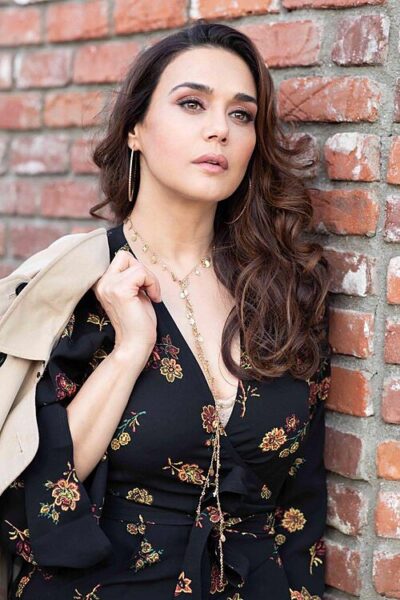
Preity Zinta
Preity Zinta is an Indian actress. Born January 31, 1975, in Shimla. Educated at St. Bede's College, Shimla. Awards include Filmfare Award for Best Actress, Filmfare Award for Best Female Debut and International Indian Film Academy Awards.
Facts
15 facts · 1 confirmed by two sources · 4 cited · 10 from one source
Where this comes from
Papalocal keeps its own record. It started from these sources; what each one said is kept here as it was copied, so a change on their side never changes this page by itself. Tap one to read its version.
What Wikidata says · copied November 16, 2026 · revision 2567088448
- Described as
- Indian actress
- Other names
- Preity G Zinta
- Born
- January 31, 1975 · 1 reference
- Born in
- Shimla · 1 reference
- Citizen of
- India
- Occupation
- film actor · 1 reference; actor · 1 reference; fashion model · 1 reference
- Education
- St. Bede's College, Shimla
- Awards
- Filmfare Award for Best Actress (2004); Filmfare Award for Best Female Debut (1998); International Indian Film Academy Awards; Stardust Awards; Bollywood Movie Awards
- Spouse
- Gene Goodenough (2016–)
- Religion
- Hinduism
- Height
- 1.59 m (5 ft 3 in)
- Wikipedias with a page
- 86
Wikidata item Q188671 (wikidata.org/wiki/Q188671), public domain (CC0). Copied November 16, 2026.
What Wikipedia says · copied November 16, 2026 · revision 1381948972
Preity G. Zinta (pronounced [ˈpɾiːt̪i ˈzɪɳʈɑː]; born 31 January 1975) is an Indian actress and entrepreneur primarily known for her work in Hindi films. After graduating with degrees in English honours and criminal psychology, Zinta made her acting debut in Dil Se in 1998, followed by a role in Soldier in the same year. These performances earned her the Filmfare Award for Best Female Debut, and she was later recognised for her role as a teenage single mother in Kya Kehna (2000). She established a career as a leading Hindi film actress of the decade with a variety of character types. Her roles, often deemed culturally defiant, along with her unconventional screen persona won her recognition and several accolades.
Following critically appreciated roles in Sangharsh (1999), Chori Chori Chupke Chupke (2001), Dil Chahta Hai (2001), Dil Hai Tumhaara (2002), and Armaan (2003), Zinta received the Filmfare Award for Best Actress for her performance in Kal Ho Naa Ho (2003). She starred in two consecutive annual top-grossing films in India, Koi... Mil Gaya (2003) and Veer-Zaara (2004), and was noted for her portrayal of independent, modern Indian women in Salaam Namaste (2005) and Kabhi Alvida Naa Kehna (2006), top-grossing productions in domestic and overseas markets. For her first international role in the Canadian drama Heaven on Earth (2008) she was awarded the Silver Hugo Award for Best Actress and nominated for the Genie Award. She followed this with a hiatus from acting work for several years, with intermittent appearances such as in her self-produced comeback film, Ishkq in Paris (2013), which failed to leave a mark.
Zinta is also a social activist, television presenter and stage performer. Between 2004 and 2005, she wrote a series of columns for BBC News Online South Asia. She is the founder of the production company PZNZ Media, a co-owner of the Indian Premier League cricket team Punjab Kings since 2008, and the owner of the South-African T20 Global League cricket team Stellenbosch Kings since 2017. Zinta is known in the Indian media for publicly speaking her mind and consequently has sparked the occasional controversy. These controversies include her being the sole witness not to retract in court her earlier statements against the Indian mafia during the 2004 Bharat Shah case, for which she was awarded the Godfrey Phillips National Bravery Award.
- Born, in its opening lines
- January 31, 1975
From the Wikipedia article “Preity Zinta” (en.wikipedia.org/wiki/Preity_Zinta), by its contributors, under CC BY-SA 4.0 (creativecommons.org/licenses/by-sa/4.0/). Copied November 16, 2026; not changed.
Confirmed Two sources agree. Cited One source, and it names where it got it. One source One source, without a reference of its own. Sources disagree The sources disagree. We show the best-supported value and keep theirs below.
