
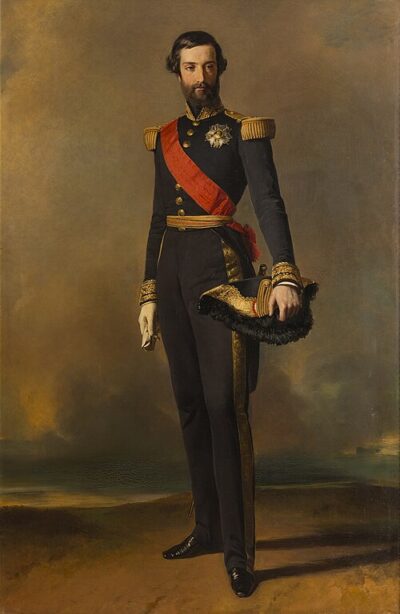
Prince François, Prince of Joinville
Prince François, Prince of Joinville was an Admiral of the French Navy. Born August 14, 1818, in Neuilly-sur-Seine. Died June 16, 1900, in Paris. Positions held include Депутат від департаменту Сена і Марна, member of the Chamber of Peers and member of the Conseil d'Amirauté. Awards include Knight of the Order of the Golden Fleece and Knight in the Order of the Holy Sepulchre.
Facts
33 facts · 2 confirmed by two sources · 5 cited · 26 from one source
Where this comes from
Papalocal keeps its own record. It started from these sources; what each one said is kept here as it was copied, so a change on their side never changes this page by itself. Tap one to read its version.
What Wikidata says · copied November 16, 2026 · revision 2565553993
- Described as
- Admiral of the French Navy (1818-1900)
- Other names
- Francois, Prince De Joinville Orleans, François-Ferdinand-Philippe-Louis-Marie d’Orléans, prince de Joinville, François-Ferdinand-Philippe-Louis-Marie d'Orléans, Prince de Joinville François d'Orléans, Francois Orleans Prince De Joinville, François d'Orléans, Prince de Joinville, Francois Ferdinand Phillippe Louis Marie d'Orleans, Prince de Joinville, François d'Orléans, François Ferdinand Philippe Louis Marie d'Orléans Joinville, Francois Ferdinand Phillippe Louis Marie d', Prince de Joinville Orleans, Francisco Ferdinando de Orleans Joinville, Francois-Ferdinand d' Orléans
- Born
- August 14, 1818 · 8 references
- Died
- June 16, 1900 · 8 references
- Born in
- Neuilly-sur-Seine
- Died in
- Paris
- Buried in
- Dreux Royal Chapel
- Cause of death
- disease
- Citizen of
- France
- Occupation
- politician; writer; Officer of the French Navy; naval officer · 1 reference; soldier · 1 reference
- Positions held
- Депутат від департаменту Сена і Марна; member of the Chamber of Peers; member of the Conseil d'Amirauté; member of the National Assembly (1871–1876) · 1 reference
- Awards
- Knight of the Order of the Golden Fleece; Knight in the Order of the Holy Sepulchre
- Spouse
- Princess Francisca of Brazil (1843–) · 2 references
- Children
- Princess Françoise of Orléans; Prince Pierre, Duke of Penthièvre; Marie Léopoldine d'Orléans · 1 reference
- Father
- Louis-Philippe I · 1 reference
- Mother
- Maria Amalia of Naples and Sicily
- Siblings
- Princess Clémentine, Princess of Koháry; Princess Marie of France; Louise of Orléans; Prince Charles, Duke of Penthièvre; Prince Louis, Duke of Nemours; Prince Ferdinand Philippe, Duke of Orléans; Prince Antoine, Duke of Montpensier; Henri d'Orléans, Duke of Aumale
- Military rank
- contre-amiral
- Wikipedias with a page
- 29
Wikidata item Q454337 (wikidata.org/wiki/Q454337), public domain (CC0). Copied November 16, 2026.
What Wikipedia says · copied November 16, 2026 · revision 1384729164
François d'Orléans, Prince de Joinville (14 August 1818 – 16 June 1900) was the third son of Louis Philippe, King of the French, and his wife Maria Amalia of Naples and Sicily. An admiral of the French Navy, François was famous for bringing the remains of Napoleon from Saint Helena to France, as well as a talented artist, with 35 known watercolours. He married Princess Francisca of Brazil, daughter of Emperor Pedro I and sister of Emperor Pedro II. The dowry received by François upon the marriage became the Brazilian city of Joinville.
François and Francisca's grandson Jean went on to become the Orléanist claimant to the extinct French throne, a claim passed on to his son, grandson and now great-grandson Jean, Count of Paris, current Orléanist claimant to the French crown.
- Born, in its opening lines
- August 14, 1818
- Died, in its opening lines
- June 16, 1900
From the Wikipedia article “François d'Orléans, Prince of Joinville” (en.wikipedia.org/wiki/François_d'Orléans,_Prince_of_Joinville), by its contributors, under CC BY-SA 4.0 (creativecommons.org/licenses/by-sa/4.0/). Copied November 16, 2026; not changed.
Confirmed Two sources agree. Cited One source, and it names where it got it. One source One source, without a reference of its own. Sources disagree The sources disagree. We show the best-supported value and keep theirs below.
