
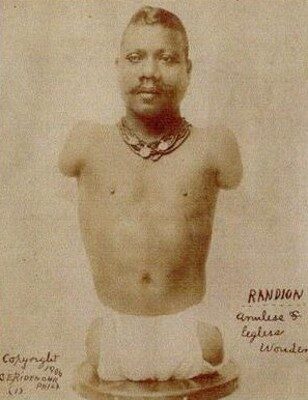
Prince Randian
Prince Randian was a sideshow performer. Born October 12, 1871, in Demerara. Died December 19, 1934, in New York City.
Facts
10 facts · 2 confirmed by two sources · 0 cited · 8 from one source
Where this comes from
Papalocal keeps its own record. It started from these sources; what each one said is kept here as it was copied, so a change on their side never changes this page by itself. Tap one to read its version.
What Wikidata says · copied November 18, 2026 · revision 2565090878
- Described as
- sideshow performer (1871–1934)
- Other names
- Randion, Rardion
- Born
- October 12, 1871 · 1 reference
- Died
- December 19, 1934
- Born in
- Demerara
- Died in
- New York City
- Cause of death
- myocardial infarction
- Citizen of
- Guyana; United States
- Occupation
- actor; circus performer
- Field
- sideshow performer
- Wikipedias with a page
- 15
Wikidata item Q1226368 (wikidata.org/wiki/Q1226368), public domain (CC0). Copied November 18, 2026.
What Wikipedia says · copied November 18, 2026 · revision 1384725440
Prince Randian (sometimes misspelled Rardion or Randion; October 12, 1871 – December 19, 1934), also nicknamed Pillow Man, The Snake Man, The Human Torso, The Human Caterpillar and a variety of other names, was a Guyanese-born American performer with tetra-amelia syndrome and a famous limbless sideshow performer of the early 1900s, best known for his ability to roll cigarettes with his lips.
He was brought to the United States by P.T. Barnum in 1889, at the age of 18, and was a popular Coney Island carnival and circus attraction for 45 years. In 1932, he was featured in the film Freaks, in which he is seen lighting up a cigarette with a match.
- Born, in its opening lines
- October 12, 1871
- Died, in its opening lines
- December 19, 1934
From the Wikipedia article “Prince Randian” (en.wikipedia.org/wiki/Prince_Randian), by its contributors, under CC BY-SA 4.0 (creativecommons.org/licenses/by-sa/4.0/). Copied November 18, 2026; not changed.
Confirmed Two sources agree. Cited One source, and it names where it got it. One source One source, without a reference of its own. Sources disagree The sources disagree. We show the best-supported value and keep theirs below.
