
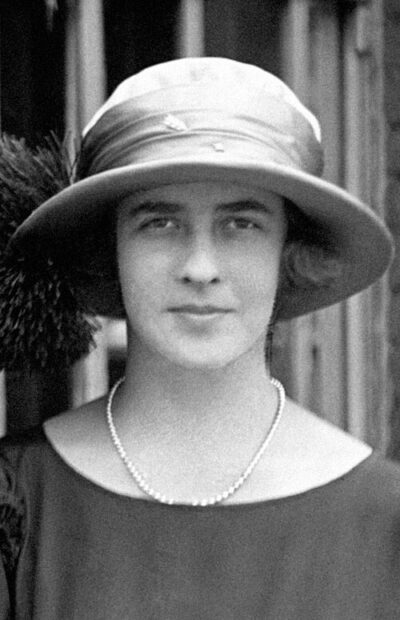
Princess Margarita of Greece and Denmark
Princess Margarita of Greece and Denmark was a Greco-Danish Royal and German Noble. Born April 18, 1905, in Old Royal Palace. Died April 24, 1981, in Bad Wiessee.
Facts
19 facts · 2 confirmed by two sources · 6 cited · 11 from one source
Where this comes from
Papalocal keeps its own record. It started from these sources; what each one said is kept here as it was copied, so a change on their side never changes this page by itself. Tap one to read its version.
What Wikidata says · copied November 16, 2026 · revision 2567492825
- Described as
- Greco-Danish Royal and German Noble
- Other names
- Margarita of Greece and Denmark, Margarita of Hohenlohe-Langenburg
- Born
- April 18, 1905 · 1 reference
- Died
- April 24, 1981 · 1 reference
- Born in
- Old Royal Palace
- Died in
- Bad Wiessee · 1 reference
- Citizen of
- Greece
- Occupation
- aristocrat
- Spouse
- Gottfried, 8th Prince of Hohenlohe-Langenburg (1931–1960) · 1 reference
- Children
- Kraft, Prince of Hohenlohe-Langenburg; stillborn daughter zu Hohenlohe-Langenburg · 2 references; Prince Andreas of Hohenlohe-Langenburg · 2 references; Princess Beatrix of Hohenlohe-Langenburg · 2 references; Prince Ruprecht of Hohenlohe-Langenburg · 2 references; Prince Albrecht zu Hohenlohe-Langenburg · 2 references
- Father
- Prince Andrew of Greece and Denmark
- Mother
- Princess Alice of Battenberg
- Siblings
- Princess Theodora of Greece and Denmark; Princess Cecilie of Greece and Denmark; Princess Sophie of Greece and Denmark; Prince Philip, Duke of Edinburgh
- Wikipedias with a page
- 33
Wikidata item Q240317 (wikidata.org/wiki/Q240317), public domain (CC0). Copied November 16, 2026.
What Wikipedia says · copied November 16, 2026 · revision 1385978961
Princess Margarita of Greece and Denmark, Princess of Hohenlohe-Langenburg (Greek: Μαργαρίτα; 18 April 1905 – 24 April 1981) was a Greek and Danish princess by birth and Princess of Hohenlohe-Langenburg by marriage. An elder sister of Prince Philip, Duke of Edinburgh (husband of Queen Elizabeth II), she was, for a time, linked to the Nazi regime.
The eldest daughter of Prince Andrew of Greece and Denmark and Princess Alice of Battenberg, Margarita spent a happy childhood between Athens and Corfu. In her youth, however, she witnessed the Balkan Wars (1912–1913), followed by the First World War (1914–1918) and the Greco-Turkish War (1919–1922). For the young princess and her relatives, these conflicts had dramatic consequences and led to their exile in Switzerland (between 1917 and 1920), then in France and the United Kingdom (from 1922 to 1936). During their exile, Margarita and her family depended on the generosity of their foreign relatives, in particular Princess George of Greece and Denmark (who offered them accommodation in Saint-Cloud) and Lady Louis Mountbatten (who supported them financially).
At the end of the 1920s, Margarita's mother had a mental health crisis which led to her confinement in a Swiss psychiatric hospital. Shortly after, in 1931, Margarita married Prince Gottfried of Hohenlohe-Langenburg. The couple then moved to Weikersheim Castle, where they raised four sons (Princes Kraft, Georg Andreas, Rupprecht and Albrecht) and a daughter (Princess Beatrix). Members of the Nazi party from 1937, Gottfried and Margarita used their family connections to promote a rapprochement of Nazism within the United Kingdom, though without success. During the 1930s, the couple also made several trips abroad. In particular, she visited New York in 1934 to testify in favor of Gloria Morgan Vanderbilt, Gottfried's former fiancée, in the case between her and her in-laws for the custody of her daughter, also named Gloria.
Affected by the Second World War, which divided her relatives into two factions, Margarita spent time in Langenburg during the conflict. The defeat of Germany and its occupation by the Allies brought new upheavals in the life of Margarita and Gottfried. Though preserved from Soviets, who caused the death of several of their cousins, the couple were ostracized by the British royal family at the time of the marriage of Prince Philip, Margarita's only brother, to Princess Elizabeth of the United Kingdom in 1947. Over the years, the couple were reintegrated into the life of the European elite, as illustrated by their invitation and presence at the coronation of Elizabeth II in 1953, and the princess's presence at the wedding of Juan Carlos, Prince of Asturias, and Princess Sophia of Greece and Denmark in 1962. Widowed in 1960, Margarita witnessed a fire at Langenburg Castle in 1963. The princess died in 1981 and her body was buried in the Hohenlohe-Langenburg family mausoleum. Margarita was the paternal aunt of the Prince of Wales, who later became King Charles III.
- Born, in its opening lines
- April 18, 1905
- Died, in its opening lines
- April 24, 1981
From the Wikipedia article “Princess Margarita of Greece and Denmark” (en.wikipedia.org/wiki/Princess_Margarita_of_Greece_and_Denmark), by its contributors, under CC BY-SA 4.0 (creativecommons.org/licenses/by-sa/4.0/). Copied November 16, 2026; not changed.
Confirmed Two sources agree. Cited One source, and it names where it got it. One source One source, without a reference of its own. Sources disagree The sources disagree. We show the best-supported value and keep theirs below.
