
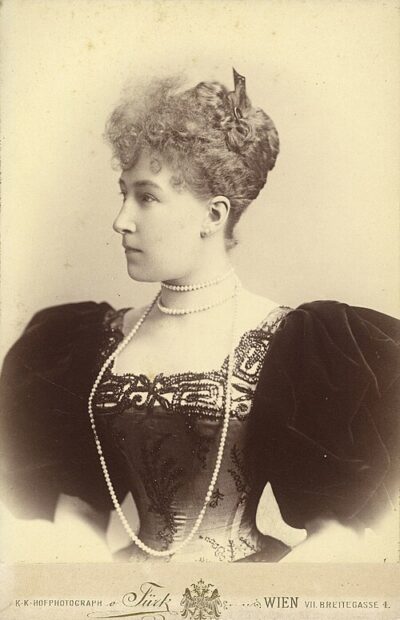
Princess Stéphanie of Belgium
Princess Stéphanie of Belgium was an Archduchess of Austria. Born May 21, 1864, in Brussels metropolitan area. Died August 23, 1945, in Pannonhalma. Known for I was to be an empress. Awards include Order of the Starry Cross.
Facts
18 facts · 2 confirmed by two sources · 3 cited · 13 from one source
Where this comes from
Papalocal keeps its own record. It started from these sources; what each one said is kept here as it was copied, so a change on their side never changes this page by itself. Tap one to read its version.
What Wikidata says · copied November 16, 2026 · revision 2557607294
- Described as
- Archduchess of Austria (1864–1945)
- Other names
- Princess Stephanie of Belgium, Stefanie van België
- Born
- May 21, 1864 · 4 references
- Died
- August 23, 1945 · 4 references
- Born in
- Brussels metropolitan area
- Died in
- Pannonhalma · 1 reference
- Buried in
- Pannonhalma Archabbey
- Citizen of
- Belgium
- Occupation
- writer · 1 reference; diarist
- Known for
- I was to be an empress
- Awards
- Order of the Starry Cross (1880–1900) · 1 reference
- Spouse
- Rudolf, Crown Prince of Austria (1881–1889) · 1 reference; Elemér Lónyay (1900–) · 1 reference
- Children
- Archduchess Elisabeth Marie of Austria
- Father
- Leopold II of Belgium
- Mother
- Marie Henriette of Austria
- Siblings
- Prince Leopold, Duke of Brabant; Clémentine of Belgium, Princess Napoléon; Princess Louise of Belgium
- Wikipedias with a page
- 39
Wikidata item Q170197 (wikidata.org/wiki/Q170197), public domain (CC0). Copied November 16, 2026.
What Wikipedia says · copied November 16, 2026 · revision 1384405426
Princess Stéphanie Clotilde Louise Herminie Marie Charlotte of Belgium (21 May 1864 – 23 August 1945) was a Belgian princess who became Crown Princess of Austria through marriage to Crown Prince Rudolf, heir-apparent to the throne of the Austro-Hungarian Empire.
Princess Stéphanie was the second daughter of King Leopold II of the Belgians and Marie Henriette of Austria. She married in Vienna on 10 May 1881 Crown Prince Rudolf, son and heir of Emperor Franz Joseph I of Austria. They had one child, Archduchess Elisabeth Marie. Stéphanie's marriage quickly became fragile. Rudolf, depressed and disappointed by politics, had multiple extramarital affairs, and contracted a venereal disease that he transmitted to his wife, rendering her unable to conceive again. In 1889, Rudolf and his mistress Mary Vetsera were found dead in an apparent murder-suicide pact at the imperial hunting lodge at Mayerling in the Vienna Woods.
In 1900, Stéphanie married again, to Count Elemér Lónyay de Nagy-Lónya et Vásáros-Namény, a Hungarian nobleman of lower rank; for this, she was excluded from the House of Habsburg. However, this second union was happy. After the death of her father in 1909, Stéphanie joined her older sister Louise to claim from the Belgian courts the share of the inheritance of which they both felt they had been stripped.
Until World War II, Count and Countess Lónyay (elevated to the princely rank in 1917) peacefully spent their lives at Rusovce Mansion in Slovakia. In 1935, Stéphanie published her memoirs, entitled Je devais être impératrice ("I Was Going To Be Empress"). In 1944, she disinherited her daughter, who had divorced to live with a socialist deputy and whom she had not seen since 1925. The arrival of the Red Army in April 1945, at the end of the war, forced Stéphanie and her husband to leave their residence and take refuge in the Pannonhalma Archabbey in Hungary. Stéphanie died of a stroke in the abbey later the same year.
- Born, in its opening lines
- May 21, 1864
- Died, in its opening lines
- August 23, 1945
From the Wikipedia article “Princess Stéphanie of Belgium” (en.wikipedia.org/wiki/Princess_Stéphanie_of_Belgium), by its contributors, under CC BY-SA 4.0 (creativecommons.org/licenses/by-sa/4.0/). Copied November 16, 2026; not changed.
Confirmed Two sources agree. Cited One source, and it names where it got it. One source One source, without a reference of its own. Sources disagree The sources disagree. We show the best-supported value and keep theirs below.
