
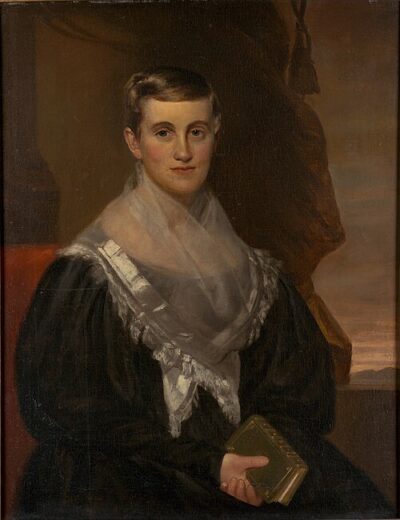
Prudence Crandall
Prudence Crandall was a Civil rights pioneer, educator, temperance advocate, Connecticut's official State Heroine. Born September 3, 1803, in Hopkinton. Died January 28, 1890, in Elk Falls. Educated at Moses Brown School. Awards include Connecticut Women's Hall of Fame and Rhode Island Heritage Hall of Fame Women inductee.
Facts
11 facts · 1 confirmed by two sources · 4 cited · 5 from one source · 1 where the sources disagree
What’s different
- Died: we show January 28, 1890 (Sources disagree). Wikipedia says January 27, 1890
Where this comes from
Papalocal keeps its own record. It started from these sources; what each one said is kept here as it was copied, so a change on their side never changes this page by itself. Tap one to read its version.
What Wikidata says · copied November 18, 2026 · revision 2565753832
- Described as
- Civil rights pioneer, educator, temperance advocate, Connecticut's official State Heroine (1803-1890)
- Born
- September 3, 1803 · 3 references
- Died
- January 28, 1890 · 3 references
- Born in
- Hopkinton · 1 reference
- Died in
- Elk Falls · 1 reference
- Buried in
- Elk Falls Cemetery · 1 reference
- Citizen of
- United States
- Occupation
- teacher · 1 reference; suffragist · 1 reference
- Education
- Moses Brown School · 1 reference
- Awards
- Connecticut Women's Hall of Fame (1994) · 1 reference; Rhode Island Heritage Hall of Fame Women inductee
- Wikipedias with a page
- 16
Wikidata item Q512490 (wikidata.org/wiki/Q512490), public domain (CC0). Copied November 18, 2026.
What Wikipedia says · copied November 18, 2026 · revision 1386069602
Prudence Crandall (September 3, 1803 – January 27, 1890) was an American schoolteacher and activist. She ran the Canterbury Female Boarding School in Canterbury, Connecticut, which became the first known school for African American girls ("young Ladies and little Misses of color") in the United States led by a white woman. She was the sister of Reuben Crandall, the defendant in the Trial of Reuben Crandall.
In 1832, when Crandall admitted Sarah Harris, a 20-year-old African American woman, to her school, she created what can be considered the first known integrated classroom in the United States. Following the decision, parents of white students began to withdraw their daughters. Rather than ask Sarah to leave, she decided that if white girls would not attend with the Black students, she would focus on educating African American girls to become teachers. She was arrested and spent a night in jail. Repeated trials for violating a Connecticut law, passed explicitly to make her work illegal, as well as violence from the townspeople, resulted in Crandall being unable to keep the school open safely. She left Connecticut and never lived there again.
Much later, the Connecticut legislature, with lobbying from Mark Twain, a resident of Hartford, passed a resolution honoring Crandall and providing her with a pension. She died a few years later, in 1890.
She was named the State Heroine of Connecticut by the Connecticut General Assembly in 1995.
- Born, in its opening lines
- September 3, 1803
- Died, in its opening lines
- January 27, 1890
From the Wikipedia article “Prudence Crandall” (en.wikipedia.org/wiki/Prudence_Crandall), by its contributors, under CC BY-SA 4.0 (creativecommons.org/licenses/by-sa/4.0/). Copied November 18, 2026; not changed.
Confirmed Two sources agree. Cited One source, and it names where it got it. One source One source, without a reference of its own. Sources disagree The sources disagree. We show the best-supported value and keep theirs below.
