
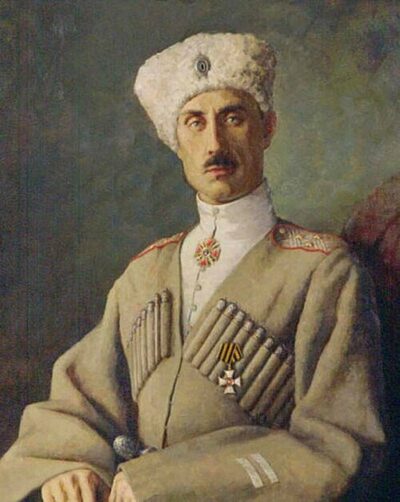
Pyotr Wrangel
Pyotr Wrangel was a Russian army general of Baltic German origin. Born August 15, 1878, in Zarasai. Died April 25, 1928, in Brussels. Educated at Nikolaevskaya Cavalry School and Saint Petersburg Mining Institute. Awards include Order of Saint Anna, 3rd class, Order of Saint Anna, 4th class and Order of Saint Stanislaus, 2nd class.
Facts
35 facts · 1 confirmed by two sources · 5 cited · 27 from one source · 2 where the sources disagree
What’s different
- Born: we show August 15, 1878 (Sources disagree). Wikipedia says August 27, 1878
- Buried in: we show Brussels (Sources disagree). Wikidata also lists Church of the Holy Trinity, Belgrade
Where this comes from
Papalocal keeps its own record. It started from these sources; what each one said is kept here as it was copied, so a change on their side never changes this page by itself. Tap one to read its version.
What Wikidata says · copied November 16, 2026 · revision 2569190912
- Described as
- Russian army general of Baltic German origin (1878-1928)
- Other names
- Pyotr Nikolayevich Wrangel
- Born
- August 15, 1878 · 2 references
- Died
- April 25, 1928 · 3 references
- Born in
- Zarasai · 1 reference
- Died in
- Brussels · 2 references
- Buried in
- Brussels · 1 reference; Church of the Holy Trinity, Belgrade · 1 reference
- Cause of death
- poisoning
- Citizen of
- Russian Empire · 1 reference
- Occupation
- military officer · 1 reference
- Political party
- White movement · 1 reference
- Education
- Nikolaevskaya Cavalry School; Saint Petersburg Mining Institute (–1901); General Staff Academy
- Awards
- Order of Saint Anna, 3rd class (1906); Order of Saint Anna, 4th class (1904); Order of Saint Stanislaus, 2nd class (1912); Order of Saint Vladimir 4th class with swords and bow (1914); Order of St. Vladimir, 3rd class with Swords (1915); Order of St. George, 4th class (1914); Medal "In memory of the 300th anniversary of Romanov dynasty" (1913); Gold Sword for Bravery (1915); Order of Saint Nicholas Thaumaturgus (1921); Cross of St. George 4th class (1917); Equestrian Order of the Holy Sepulchre (1920); Order of Saint Stanislaus · 1 reference
- Field
- military leader · 1 reference; White movement · 1 reference
- Spouse
- Olga Wrangel
- Children
- Baron Alexis Wrangel · 1 reference
- Father
- Nikolay Wrangel
- Mother
- Mariâ Dmitrievna Vrangelʹ
- Religion
- Eastern Orthodoxy · 1 reference
- Military branch
- Imperial Russian Army; cavalry
- Military rank
- lieutenant general (1918); major general (1917)
- Wikipedias with a page
- 59
Wikidata item Q108260 (wikidata.org/wiki/Q108260), public domain (CC0). Copied November 16, 2026.
What Wikipedia says · copied November 16, 2026 · revision 1382637885
Baron Pyotr Nikolayevich Wrangel (27 August [O.S. 15 August] 1878 – 25 April 1928), nicknamed the "Black Baron", was a Russian military officer who served as a commanding general in the anti-Bolshevik Volunteer Army during the Russian Civil War. In 1920, he became the last commander-in-chief of the White forces in Southern Russia, which he reorganized as the Russian Army.
A scion of the prominent Baltic German Wrangel noble family, Wrangel initially pursued a civilian career at his father's behest, graduating as a mining engineer, but later decided on a military career after volunteering for service in the Russo-Japanese War. A graduate of the Imperial General Staff Academy, he distinguished himself during World War I, becoming one of the first Russian officers to be awarded the Order of St. George for heroism. He rose to the rank of major general.
After the October Revolution, Wrangel joined the Volunteer Army in August 1918 and was given command of major cavalry formations. He became known for his aggressive leadership and battlefield successes in the Northern Caucasus. In 1919, he captured the strategic city of Tsaritsyn but soon clashed with his superior, Anton Denikin, over the latter's Moscow Directive, a plan Wrangel considered strategically flawed. The growing rivalry led to his dismissal from command in December 1919.
Following Denikin's resignation in April 1920, Wrangel was elected commander-in-chief of the shattered White forces in Crimea. He established the Government of South Russia and attempted to win popular support with a wide-ranging series of reforms, including a radical land reform. After initial military successes against the Red Army, his forces were defeated, and he organized a mass evacuation from Crimea in November 1920, successfully evacuating over 145,000 people. In exile, he remained a leader of the White movement and founded the Russian All-Military Union (ROVS) in 1924. He is remembered as the last commander of the White Army, a more able administrator and strategist than his predecessors, who took command when the White cause was already considered lost.
- Born, in its opening lines
- August 27, 1878
- Died, in its opening lines
- April 25, 1928
From the Wikipedia article “Pyotr Wrangel” (en.wikipedia.org/wiki/Pyotr_Wrangel), by its contributors, under CC BY-SA 4.0 (creativecommons.org/licenses/by-sa/4.0/). Copied November 16, 2026; not changed.
Confirmed Two sources agree. Cited One source, and it names where it got it. One source One source, without a reference of its own. Sources disagree The sources disagree. We show the best-supported value and keep theirs below.
