
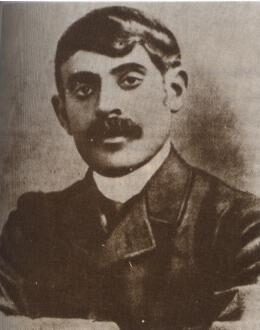
Qasim Amin
Qasim Amin was an Egyptian writer, judge and social reformer. Born December 1, 1863, in Alexandria. Died 1908, in Cairo. Educated at University of Montpellier.
Facts
19 facts · 2 confirmed by two sources · 8 cited · 9 from one source
What’s different
- Died: we show 1908 (Confirmed). Wikidata also lists April 23, 1908
Where this comes from
Papalocal keeps its own record. It started from these sources; what each one said is kept here as it was copied, so a change on their side never changes this page by itself. Tap one to read its version.
What Wikidata says · copied November 16, 2026 · revision 2536786307
- Described as
- Egyptian writer, judge and social reformer (1863–1908)
- Born
- December 1, 1863
- Died
- April 23, 1908; 1908 · 1 reference
- Born in
- Alexandria
- Died in
- Cairo
- Cause of death
- myocardial infarction
- Citizen of
- Ottoman Empire
- Occupation
- writer · 2 references; women's rights activist; jurist · 1 reference; philosopher · 1 reference; Protestant reformer · 1 reference; public figure · 1 reference; politician · 1 reference; reformer · 1 reference
- Education
- University of Montpellier (1881–1885)
- Field
- law · 1 reference; feminism · 1 reference; philosophy · 1 reference
- Religion
- Islam
- Wikipedias with a page
- 31
Wikidata item Q740282 (wikidata.org/wiki/Q740282), public domain (CC0). Copied November 16, 2026.
What Wikipedia says · copied November 16, 2026 · revision 1382370994
Qasim Amin (pronounced [ˈʔæːsem ʔæˈmiːn], Egyptian Arabic: قاسم أمين; 1 December 1863 – 12 April 1908) was an Egyptian jurist, Islamic Modernist and one of the founders of the Egyptian national movement, as well as a co-founder of Cairo University. Qasim Amin was one of the Arab world's "first feminists" though his "feminism" has been the subject of scholarly controversy. His advocacy of greater rights for women catalyzed debate over women's issues in the Arab world. He criticized veiling, seclusion, early marriage, and lack of education of Muslim women.
Greatly influenced by the works of Darwin, Amin argued for the modernization of Egypt along European lines. He was also influenced by the works of Herbert Spencer and John Stuart Mill who argued for equality of the sexes. Amin believed that heightening women's status in society must greatly improve the nation. Amin blamed traditional Muslims for Egyptian women's oppression, saying that the Quran does not teach this subjugation but rather supports women's rights. His beliefs were often supported by Quranic verses.
- Born, in its opening lines
- December 1, 1863
- Died, in its opening lines
- April 12, 1908
From the Wikipedia article “Qasim Amin” (en.wikipedia.org/wiki/Qasim_Amin), by its contributors, under CC BY-SA 4.0 (creativecommons.org/licenses/by-sa/4.0/). Copied November 16, 2026; not changed.
Confirmed Two sources agree. Cited One source, and it names where it got it. One source One source, without a reference of its own. Sources disagree The sources disagree. We show the best-supported value and keep theirs below.
