
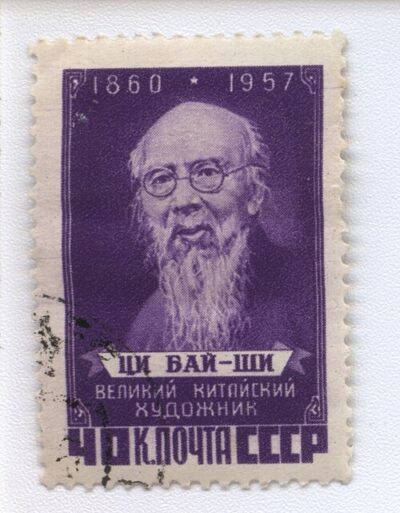
Qi Baishi
Qi Baishi was a Chinese painter. Born January 1, 1864, in Xiangtan County. Died September 16, 1957, in Beijing. Positions held include National People's Congress deputy. Known for The Palm Tree.
Facts
18 facts · 2 confirmed by two sources · 8 cited · 8 from one source
Where this comes from
Papalocal keeps its own record. It started from these sources; what each one said is kept here as it was copied, so a change on their side never changes this page by itself. Tap one to read its version.
What Wikidata says · copied November 16, 2026 · revision 2558219218
- Described as
- Chinese painter (1864-1957)
- Other names
- Pai-schi Tschi, Pai-shih-lao-jen, Pin-sheng Chʻi, Wei-chʻing Chʻi, Pai-shih Chʻi, Chʻun-chih Chʻi, Huang Qi, Lanting Qi, Hakuseki Sei, Weiqing Qi, Pai-shih-shan-jen, Hakuseki Sai
- Born
- January 1, 1864 · 6 references
- Died
- September 16, 1957 · 7 references
- Born in
- Xiangtan County · 1 reference
- Died in
- Beijing · 1 reference
- Citizen of
- Qing dynasty; People's Republic of China · 1 reference; Republic of China · 1 reference
- Occupation
- painter · 4 references; politician; poet · 1 reference; calligrapher · 1 reference; xylographer · 1 reference; seal cutter
- Positions held
- National People's Congress deputy
- Genre
- landscape painting
- Known for
- The Palm Tree
- Field
- painting · 1 reference
- Children
- Qi Liangyi
- Wikipedias with a page
- 34
Wikidata item Q369608 (wikidata.org/wiki/Q369608), public domain (CC0). Copied November 16, 2026.
What Wikipedia says · copied November 16, 2026 · revision 1371996013
Qi Baishi (1 January 1864 – 16 September 1957) was a Chinese painter, noted for the whimsical, often playful style of his works. Born to a peasant family from Xiangtan, Hunan, Qi taught himself to paint, sparked by the Manual of the Mustard Seed Garden. After he turned 40, he traveled, visiting various scenic spots in China. After 1917 he settled in Beijing. Qi was the master of Hu Jieqing, the wife of Lao She.
The subjects of his paintings include almost everything, commonly animals, scenery, figures, toys, vegetables, and so on. He theorized that "paintings must be something between likeness and unlikeness, much like today's vulgarians, but not like to cheat popular people". In his later years, many of his works depict mice, shrimp or birds. He was also good at seal carving and called himself "the rich man of three hundred stone seals" (三百石印富翁). In 1953, he was elected president of the China Artists Association (中國美術家協會). He died in Beijing in 1957.
- Born, in its opening lines
- January 1, 1864
- Died, in its opening lines
- September 16, 1957
From the Wikipedia article “Qi Baishi” (en.wikipedia.org/wiki/Qi_Baishi), by its contributors, under CC BY-SA 4.0 (creativecommons.org/licenses/by-sa/4.0/). Copied November 16, 2026; not changed.
Confirmed Two sources agree. Cited One source, and it names where it got it. One source One source, without a reference of its own. Sources disagree The sources disagree. We show the best-supported value and keep theirs below.
