
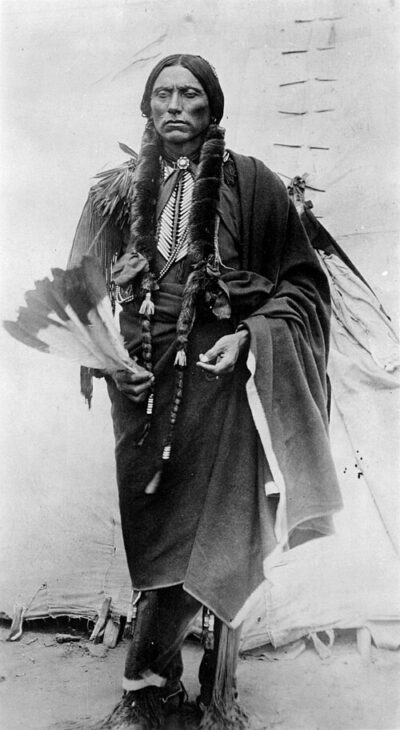
Quanah Parker
Quanah Parker was a Native American Indian leader. Born 1845, in Indian Territory. Died February 23, 1911, in Quanah Parker Star House.
Facts
18 facts · 2 confirmed by two sources · 10 cited · 6 from one source
What’s different
- Born: we show 1845 (Confirmed). Wikidata also lists 1853
Where this comes from
Papalocal keeps its own record. It started from these sources; what each one said is kept here as it was copied, so a change on their side never changes this page by itself. Tap one to read its version.
What Wikidata says · copied November 16, 2026 · revision 2567374988
- Described as
- Native American Indian leader (1845–1911)
- Other names
- Quanah
- Born
- 1845 · 2 references; 1853 · 1 reference
- Died
- February 23, 1911 · 2 references
- Born in
- Indian Territory
- Died in
- Quanah Parker Star House
- Buried in
- Fort Sill Post Cemetery (1957–) · 2 references
- Citizen of
- United States
- Occupation
- traditional leader or chief · 1 reference; spiritual leader · 1 reference; rancher · 1 reference; merchant · 1 reference
- Field
- chiefdom · 1 reference; ethnic religion · 1 reference; military art · 1 reference; Comanche · 1 reference; peace treaty · 1 reference
- Father
- Peta Nocona
- Mother
- Cynthia Ann Parker
- Religion
- Native American Church
- Wikipedias with a page
- 22
Wikidata item Q1343075 (wikidata.org/wiki/Q1343075), public domain (CC0). Copied November 16, 2026.
What Wikipedia says · copied November 16, 2026 · revision 1385384353
Quanah Parker (Comanche: Kwana, lit. 'smell, odor'; c. 1845 – February 23, 1911) was a Euro-Indigenous American war leader of the Kwahadi ("Antelope") band of the Comanche Nation. He was likely born into the Nokoni ("Wanderers") band of Tabby-nocca and grew up among the Kwahadis, the son of Kwahadi Comanche chief Peta Nocona and Cynthia Ann Parker, an Anglo-American who had been abducted as a nine-year-old child during the Fort Parker massacre in 1836 and assimilated into the Nokoni tribe. Following the apprehension of several Kiowa chiefs in 1871, Quanah Parker emerged as a dominant figure in the Red River War, clashing repeatedly with Colonel Ranald S. Mackenzie. With European-Americans hunting American bison, the Comanches' primary sustenance, into near extinction, Quanah Parker eventually surrendered and peaceably led the Kwahadi to the reservation at Fort Sill, Oklahoma.
Quanah Parker was never elected chief by his people but was appointed by the federal government as principal chief of the entire Comanche Nation. He became a primary emissary of southwest Native Americans to the United States legislature. In civilian life, he gained wealth as a rancher, settling near Cache, Oklahoma. Though he encouraged Christianization of Comanche people, he also advocated the syncretic Native American Church alternative, and fought for the legal use of peyote in the movement's religious practices. He was elected deputy sheriff of Lawton in 1902. After his death in 1911, the leadership title of Chief was replaced with chairman; Quanah Parker is thereby described as the "Last Chief of the Comanche", a term also applied to Horseback.
He is buried at Chief's Knoll on Fort Sill. Many cities and highway systems in southwest Oklahoma and north Texas, once southern Comancheria, bear reference to his name.
- Born, in its opening lines
- c. 1845
- Died, in its opening lines
- February 23, 1911
From the Wikipedia article “Quanah Parker” (en.wikipedia.org/wiki/Quanah_Parker), by its contributors, under CC BY-SA 4.0 (creativecommons.org/licenses/by-sa/4.0/). Copied November 16, 2026; not changed.
Confirmed Two sources agree. Cited One source, and it names where it got it. One source One source, without a reference of its own. Sources disagree The sources disagree. We show the best-supported value and keep theirs below.
