
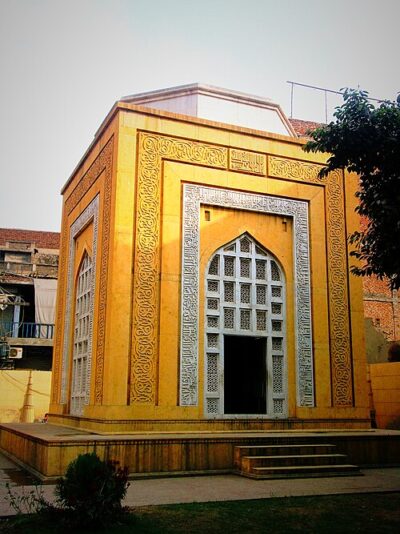
Qutb-ud-din Aibak
Qutb-ud-din Aibak was a founded of the Mamluk Dynasty. Born 1150, in Central Asia. Died November 4, 1210, in Lahore. Positions held include Sultan of Hindustan (Sultan of Delhi) (1206–1210).
Facts
11 facts · 2 confirmed by two sources · 0 cited · 9 from one source
Where this comes from
Papalocal keeps its own record. It started from these sources; what each one said is kept here as it was copied, so a change on their side never changes this page by itself. Tap one to read its version.
What Wikidata says · copied November 16, 2026 · revision 2532458136
- Described as
- founded of the Mamluk Dynasty (1150-1210)
- Other names
- Qutb al-Din Aibak
- Born
- 1150
- Died
- November 4, 1210
- Born in
- Central Asia
- Died in
- Lahore
- Cause of death
- horse fall
- Occupation
- politician; Sultan of Hindustan (Sultan of Delhi)
- Positions held
- Sultan of Hindustan (Sultan of Delhi) (1206–1210)
- Children
- Qutub Begum; Aram Shah
- Religion
- Sunni Islam
- Wikipedias with a page
- 44
Wikidata item Q311151 (wikidata.org/wiki/Q311151), public domain (CC0). Copied November 16, 2026.
What Wikipedia says · copied November 16, 2026 · revision 1385347146
Qutb ud-Din Aibak (Persian: قطبالدین ایبک; 1150 – 4 November 1210) was a Turkic general of the Ghurid emperor Muhammad Ghori. He was in charge of the Ghurid territories in northern India, and after Muhammad Ghori's assassination in 1206, he established his own independent rule in Lahore and Delhi, laying the foundations for the Sultanate of Delhi.
A native of Turkestan, Aibak was sold into slavery as a child. He was purchased by a qazi at Nishapur in Persia, where he learned archery and horse-riding among other skills. He was subsequently resold to Muhammad Ghori in Ghazni, where he rose to the position of the officer of the royal stables. During the Khwarazmian-Ghurid wars, he was captured by the scouts of Sultan Shah; after the Ghurid victory, he was released and highly favoured by Muhammad Ghori.
After the Ghurid victory in the Second Battle of Tarain in 1192, Muhammad Ghori made Aibak in charge of his Indian territories. Aibak expanded the Ghurid power in northern India by conquering and raiding several places in the Chahamana, Gahadavala, Chaulukya, Chandela, and other kingdoms.
After the assassination of Muhammad Ghori in March 1206, Aibak fought with another former slave-general Taj al-Din Yildiz for control of Ghurid territories in north-western India. During this campaign, he advanced as far as Ghazni, although he later retreated and set up his capital at Lahore. He nominally acknowledged the suzerainty of Muhammad Ghori's successor Ghiyasuddin Mahmud, who officially recognized him as the ruler of India.
Aibak was succeeded by Aram Shah, and then by his former slave and son-in-law Iltutmish, who transformed the loosely-held Ghurid territories of India into the powerful Delhi Sultanate. Aibak is known for having commissioned the Qutb Minar in Delhi, and the Adhai Din Ka Jhonpra in Ajmer.
- Born, in its opening lines
- 1150
- Died, in its opening lines
- November 4, 1210
From the Wikipedia article “Qutb ud-Din Aibak” (en.wikipedia.org/wiki/Qutb_ud-Din_Aibak), by its contributors, under CC BY-SA 4.0 (creativecommons.org/licenses/by-sa/4.0/). Copied November 16, 2026; not changed.
Confirmed Two sources agree. Cited One source, and it names where it got it. One source One source, without a reference of its own. Sources disagree The sources disagree. We show the best-supported value and keep theirs below.
