
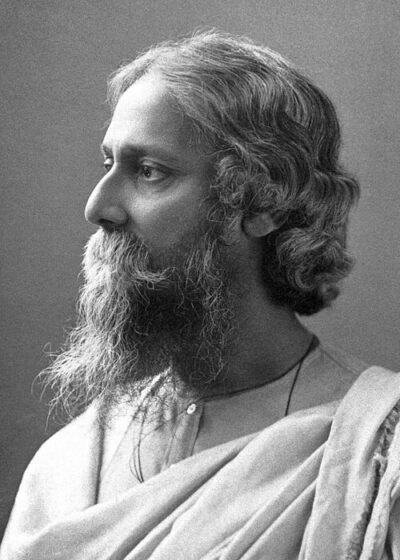
Rabindranath Tagore
Rabindranath Tagore was a Bengali poet, philosopher and polymath. Born May 7, 1861, in Kolkata. Died August 7, 1941, in Kolkata. Known for Gitanjali, Ghare-Bhaire and Bhanusimha Thakurer Padabali. Educated at University College London and St. Xavier's Collegiate School. Awards include Nobel Prize in Literature, honorary doctor of the University of Calcutta and Knight Bachelor.
Facts
50 facts · 2 confirmed by two sources · 33 cited · 15 from one source
Where this comes from
Papalocal keeps its own record. It started from these sources; what each one said is kept here as it was copied, so a change on their side never changes this page by itself. Tap one to read its version.
What Wikidata says · copied November 16, 2026 · revision 2567669716
- Described as
- Bengali poet, philosopher and polymath (1861–1941)
- Other names
- Biswakabi, Tagore, Nyi Wang Gönpo, Kabiguru, Rabindranat Tagor, Rabīndranātha Thākur, Ravindranath Thakur, Bishwakabi, R. Tagore, Gurudev, Tagore, rabindranath, Bhanu Singha Thakur
- Born
- May 7, 1861 · 9 references
- Died
- August 7, 1941 · 15 references
- Born in
- Kolkata · 8 references
- Died in
- Kolkata · 7 references
- Buried in
- Ganges
- Cause of death
- disease
- Citizen of
- British Raj · 4 references
- Occupation
- painter · 3 references; poet · 3 references; composer · 4 references; playwright · 4 references; essayist · 1 reference; philosopher · 5 references; artist · 3 references; writer · 7 references
- Education
- University College London · 1 reference; St. Xavier's Collegiate School
- Genre
- essay · 1 reference; novella · 1 reference
- Instrument
- voice
- Known for
- Gitanjali · 1 reference; Ghare-Bhaire · 2 references; Bhanusimha Thakurer Padabali · 1 reference; Valmikipratibha · 1 reference; Kabuliwala; Kshudhita Pashan; Nastanirh; Noukadubi; Chaturanga; Jogajog
- Awards
- Nobel Prize in Literature (1913) · 4 references; honorary doctor of the University of Calcutta; Knight Bachelor (1915–1919) · 2 references
- Field
- literature · 1 reference; poetry · 1 reference; short story · 1 reference; creative and professional writing · 1 reference; music composition · 1 reference; drama · 1 reference
- Spouse
- Mrinalini Devi (1883–1902) · 1 reference
- Children
- Rathindranath Tagore · 1 reference
- Father
- Debendranath Tagore · 2 references
- Siblings
- Swarnakumari Devi · 1 reference; Hemendranath Tagore · 1 reference; Jyotirindranath Tagore · 1 reference; Dwijendranath Tagore · 1 reference; Satyendranath Tagore · 1 reference; Soudamini Debi · 1 reference
- Religion
- Hinduism · 1 reference; Brahmo
- Wikipedias with a page
- 248
Wikidata item Q7241 (wikidata.org/wiki/Q7241), public domain (CC0). Copied November 16, 2026.
What Wikipedia says · copied November 16, 2026 · revision 1383900540
Rabindranath Tagore (Bengali: [ˈrobind̪ɾonat̪ʰ ˈʈʰakuɾ] ; 7 May 1861 – 7 August 1941) was a Bengali polymath - who worked as a poet, author, playwright, musician, composer, philosopher, social reformer, painter, and was one of the foremost figures of the Bengal Renaissance. In 1913, Tagore became the first Indian and non-European to win a Nobel Prize in any category, and also the first lyricist to win the Nobel Prize in Literature. A significant moulder of culture within Bengal and the Indian subcontinent, he wrote and composed the national anthems of India and Bangladesh.
He reshaped Bengali literature and music as well as Indian art with Contextual Modernism in the late 19th and early 20th centuries. He was the author of the "profoundly sensitive, fresh and beautiful" poetry of Gitanjali. Tagore's poetic songs were viewed as spiritual and mercurial; his elegant prose and magical poetry were widely popular in the Indian subcontinent. He was a fellow of the Royal Asiatic Society. Referred to as "the Bard of Bengal", Tagore was known by the sobriquets Gurudeb, Kobiguru, and Bishwokobi.
A Bengali Brahmin from Calcutta with ancestral gentry roots in Jessore and Bardhaman districts, Tagore wrote poetry as an eight-year-old. At the age of sixteen, he released his first substantial poems under the pseudonym Bhānusiṃha ("Sun Lion"), which were seized upon by literary authorities as long-lost classics. By 1877 he graduated to his first short stories and dramas, published under his real name. As a humanist, universalist, internationalist, and ardent critic of nationalism, he denounced the British Raj and advocated independence from Britain. As an exponent of the Bengal Renaissance, he advanced a vast canon that comprised paintings, sketches and doodles, hundreds of texts, and some two thousand songs; his legacy also endures in his founding of Visva-Bharati University.
Tagore modernised Bengali art by spurning rigid classical forms and resisting linguistic strictures. His novels, stories, songs, dance dramas, and essays spoke to topics political and personal. Gitanjali (Song Offerings), Gora (Fair-Faced), and Ghare-Baire (The Home and the World) are his best-known works. His poetry, short stories, and novels were both praised and criticised for their lyricism, colloquial tone, naturalism, and philosophical introspection. His compositions were chosen by two nations as national anthems: India's "Jana Gana Mana" and Bangladesh's "Amar Sonar Bangla". The Sri Lankan national anthem was also inspired by his work. His song "Banglar Mati Banglar Jol" has been adopted as the state anthem of West Bengal.
- Born, in its opening lines
- May 7, 1861
- Died, in its opening lines
- August 7, 1941
From the Wikipedia article “Rabindranath Tagore” (en.wikipedia.org/wiki/Rabindranath_Tagore), by its contributors, under CC BY-SA 4.0 (creativecommons.org/licenses/by-sa/4.0/). Copied November 16, 2026; not changed.
Confirmed Two sources agree. Cited One source, and it names where it got it. One source One source, without a reference of its own. Sources disagree The sources disagree. We show the best-supported value and keep theirs below.
