
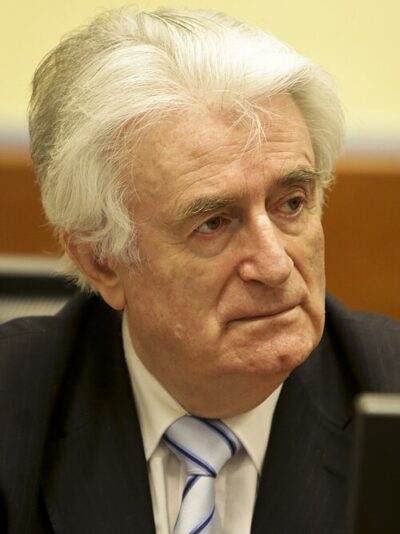
Radovan Karadžić
Radovan Karadžić is a Bosnian Serb politician, psychiatrist and poet convicted of genocide. Born June 19, 1945, in Petnjica. Positions held include President of Republika Srpska (1992–1996). Educated at University of Sarajevo and Columbia University Vagelos College of Physicians and Surgeons. Awards include Order of the Republika Srpska and Mikhail Sholokhov International Award for Literature and Art.
Facts
19 facts · 1 confirmed by two sources · 4 cited · 14 from one source
Where this comes from
Papalocal keeps its own record. It started from these sources; what each one said is kept here as it was copied, so a change on their side never changes this page by itself. Tap one to read its version.
What Wikidata says · copied November 16, 2026 · revision 2569141107
- Described as
- Bosnian Serb politician, psychiatrist and poet convicted of genocide
- Other names
- Dragan David Dabić, Karadzic Radovan, D3, Petar Glumac, Radovan V. Karadžić, Radovan Karadzic, Dragan Dabić
- Born
- June 19, 1945 · 5 references
- Born in
- Petnjica
- Citizen of
- Bosnia and Herzegovina; Socialist Federal Republic of Yugoslavia; Republika Srpska; Serbia
- Occupation
- politician · 1 reference; poet · 1 reference; psychiatrist · 1 reference
- Positions held
- President of Republika Srpska (1992–1996)
- Political party
- Serbian Democratic Party; League of Communists of Yugoslavia
- Education
- University of Sarajevo · 1 reference; Columbia University Vagelos College of Physicians and Surgeons
- Awards
- Order of the Republika Srpska; Mikhail Sholokhov International Award for Literature and Art
- Spouse
- Ljiljana Zelen Karadžić
- Children
- Sonja Karadžić-Jovičević
- Religion
- Eastern Orthodoxy
- Wikipedias with a page
- 92
Wikidata item Q123923 (wikidata.org/wiki/Q123923), public domain (CC0). Copied November 16, 2026.
What Wikipedia says · copied November 16, 2026 · revision 1385786323
Radovan Karadžić (Serbian Cyrillic: Радован Караџић, pronounced [râdovaːn kâradʒitɕ]; born 19 June 1945) is a Bosnian Serb former politician who served as the president of Republika Srpska during the Bosnian War. He was convicted of genocide, crimes against humanity, and war crimes by the International Criminal Tribunal for the former Yugoslavia (ICTY).
Trained as a psychiatrist, he co-founded the Serb Democratic Party in Bosnia and Herzegovina and served as the first president of Republika Srpska from 1992 to 1996. He was a fugitive from 1996 until July 2008, after having been indicted for war crimes by the ICTY. The indictment concluded there were reasonable grounds for believing he committed war crimes, including genocide against Bosniak and Croat civilians during the Bosnian War (1992–1995). While a fugitive, he worked at a private clinic in Belgrade, specializing in alternative medicine and psychology, under an alias.
He was arrested in Belgrade in 2008 and brought before Belgrade's War Crimes Court a few days later. Extradited to the Netherlands, he was placed in the custody of the ICTY in the United Nations Detention Unit of Scheveningen, where he was charged with 11 counts of war crimes and crimes against humanity. He is sometimes referred to by the Western media as the "Butcher of Bosnia", a sobriquet also applied to former Army of Republika Srpska (VRS) General Ratko Mladić. In 2016, he was found guilty of the genocide in Srebrenica, war crimes, and crimes against humanity, 10 of the 11 charges in total, and sentenced to 40 years' imprisonment. In 2019, an appeal he had filed against his conviction was rejected, and the sentence was increased to life imprisonment. He is serving his sentence in a British prison, HMP Parkhurst on the Isle of Wight.
- Born, in its opening lines
- June 19, 1945
From the Wikipedia article “Radovan Karadžić” (en.wikipedia.org/wiki/Radovan_Karadžić), by its contributors, under CC BY-SA 4.0 (creativecommons.org/licenses/by-sa/4.0/). Copied November 16, 2026; not changed.
Confirmed Two sources agree. Cited One source, and it names where it got it. One source One source, without a reference of its own. Sources disagree The sources disagree. We show the best-supported value and keep theirs below.
