
Rædwald of East Anglia
Rædwald of East Anglia was the 7th-century Anglo-Saxon king. Born 6th century. Died 624. Positions held include King of East Anglia (600–624).
Facts
11 facts · 0 confirmed by two sources · 0 cited · 11 from one source
Where this comes from
Papalocal keeps its own record. It started from these sources; what each one said is kept here as it was copied, so a change on their side never changes this page by itself. Tap one to read its version.
What Wikidata says · copied November 16, 2026 · revision 2557347409
- Described as
- 7th-century Anglo-Saxon king
- Other names
- Raedwald
- Born
- 6th century
- Died
- 624
- Occupation
- sovereign
- Positions held
- King of East Anglia (600–624)
- Children
- Eorpwald of East Anglia; Rægenhere; Sigeberht; Ecgric of East Anglia; Ricberht of East Anglia
- Father
- Tytila of East Anglia
- Siblings
- Eni of East Anglia
- Wikipedias with a page
- 31
Wikidata item Q468836 (wikidata.org/wiki/Q468836), public domain (CC0). Copied November 16, 2026.
What Wikipedia says · copied November 16, 2026 · revision 1375184886
Rædwald (Old English: Rædwald, pronounced [ˈrædwɑɫd]; 'power in counsel'), also written as Raedwald or Redwald (Latin: Raedwaldus, Reduald), (died c. 624) was a king of East Anglia, an Anglo-Saxon kingdom which included the present-day English counties of Norfolk and Suffolk. He was the son of Tytila of East Anglia and a member of the Wuffingas dynasty (named after his grandfather, Wuffa), who were the first kings of the East Angles. Details about Rædwald's reign are scarce, primarily because the Viking invasions of the 9th century destroyed the monasteries in East Anglia where many documents would have been kept. Rædwald reigned from about 599 until his death around 624, initially under the overlordship of Æthelberht of Kent. In 616, as a result of fighting the Battle of the River Idle and defeating Æthelfrith of Northumbria, he was able to install Edwin, who was acquiescent to his authority, as the new king of Northumbria. During the battle, both Æthelfrith and Rædwald's son, Rægenhere, were killed.
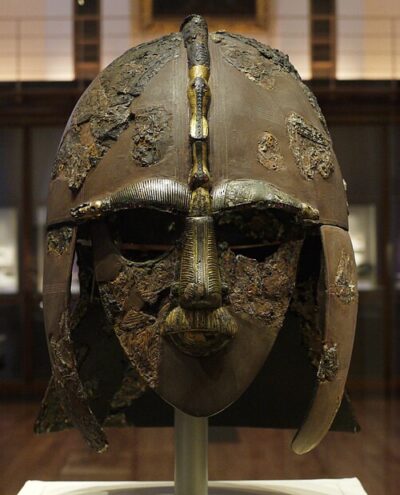
From around 616 Rædwald was the most powerful of the English kings south of the Humber estuary. According to Bede, he was the fourth ruler to hold imperium over other southern Anglo-Saxon kingdoms: he was referred to in the Anglo-Saxon Chronicle, written centuries after his death, as a bretwalda (an Old English term meaning 'Britain-ruler' or 'wide-ruler'). He was the first king of the East Angles to become a Christian, converting at Æthelberht's court some time before 605, while also maintaining a pagan temple. He helped Christianity to survive in East Anglia during the apostasy of the Anglo-Saxon kingdoms of Essex and Kent. Historians consider him the most likely occupant of the Sutton Hoo ship-burial, although other theories have been advanced. A smaller ship-burial was also discovered in 1998 close to the original Sutton Hoo site, which is thought to have contained the body of his son Rægenhere, who died in battle in 616.
From the Wikipedia article “Rædwald of East Anglia” (en.wikipedia.org/wiki/Rædwald_of_East_Anglia), by its contributors, under CC BY-SA 4.0 (creativecommons.org/licenses/by-sa/4.0/). Copied November 16, 2026; not changed.
Confirmed Two sources agree. Cited One source, and it names where it got it. One source One source, without a reference of its own. Sources disagree The sources disagree. We show the best-supported value and keep theirs below.
