
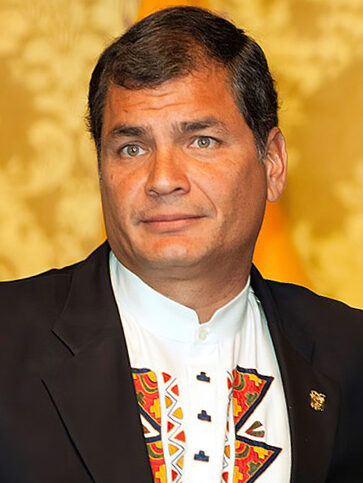
Rafael Correa
Rafael Correa is a President of Ecuador (2007 - 2017) y Prófugo de la Justicia. Born April 6, 1963, in Guayaquil. Positions held include Minister of Finance (2005), President of Ecuador (2007–2017) and President of PAIS Alliance (2006–2017). Educated at University of Illinois Urbana-Champaign and UCLouvain. Awards include National Order of San Lorenzo, Order of the Liberator and Order of Francisco Morazán.
Facts
44 facts · 1 confirmed by two sources · 13 cited · 30 from one source
Where this comes from
Papalocal keeps its own record. It started from these sources; what each one said is kept here as it was copied, so a change on their side never changes this page by itself. Tap one to read its version.
What Wikidata says · copied November 16, 2026 · revision 2567894273
- Described as
- President of Ecuador (2007 - 2017) y Prófugo de la Justicia
- Other names
- Rafael Correa Delgado, Rafael Vicente Correa Delgado, Mashi Rafael
- Born
- April 6, 1963 · 4 references
- Born in
- Guayaquil · 2 references
- Citizen of
- Ecuador · 3 references
- Occupation
- economist · 1 reference; politician · 1 reference
- Positions held
- Minister of Finance (2005) · 1 reference; President of Ecuador (2007–2017); President of PAIS Alliance (2006–2017); President pro tempore of the Union of South American Nations (2009–2010)
- Political party
- PAIS Alliance (2006–2018); Citizen Revolution Movement (2018–)
- Worked for
- RT en español (2018–) · 1 reference; Universidad Católica de Santiago de Guayaquil (1983–1993); Universidad San Francisco de Quito (2 times) (1993–2005); University of Illinois Urbana-Champaign (1997–2001); Government of Ecuador (2 times) (2005–2017); Inter-American Development Bank (1992–1996); Alfredo Palacio (2003–2005)
- Education
- University of Illinois Urbana-Champaign (–2001); UCLouvain (–1991) · 1 reference; Universidad Católica de Santiago de Guayaquil (–1987) · 1 reference
- Member of
- Puebla Group (2019–); Progressive International (2020–) · 1 reference
- Awards
- National Order of San Lorenzo (2007); Order of the Liberator (2007); Order of Francisco Morazán (2009); Grand Cross of the Order of the Liberator General San Martín (2008) · 1 reference; Order of Augusto César Sandino (2010) · 1 reference; Order of José Martí (2017) · 1 reference; honorary doctor of the Moscow State Institute of International Relations · 1 reference; Grand Cross, Special Class of the Order of the Sun of Peru (2010) · 1 reference; Grand Cross with Chain of the Order of Merit of the Republic of Hungary (civil); honorary doctorate of Barcelona University; Honorary Doctorate of University of Buenos Aires; honorary doctor of the University of Havana; honorary doctor of the University of Santiago, Chile; honorary doctor of the University of Chile; honorary doctor of the National University of Córdoba
- Spouse
- Anne Malherbe Gosselin (1992–)
- Children
- Anne-Dominique Correa
- Father
- Rafael Correa Icaza
- Mother
- Norma Delgado
- Religion
- Catholicism
- Lived in
- Brussels (2017–) · 1 reference
- Wikipedias with a page
- 173
Wikidata item Q19581 (wikidata.org/wiki/Q19581), public domain (CC0). Copied November 16, 2026.
What Wikipedia says · copied November 16, 2026 · revision 1385017334
Rafael Vicente Correa Delgado (Spanish pronunciation: [rafaˈel βiˈsente koˈre.a ðelˈɣaðo]; born 6 April 1963) is an Ecuadorian politician and economist who served as the 45th president of Ecuador from 2007 to 2017. The leader of the PAIS Alliance political movement from its foundation until 2017, Correa is a democratic socialist and his administration focused on the implementation of left-wing policies. Internationally, he served as president pro tempore of the UNASUR. Since 2017, he has been living with his family in Belgium.
Born to a lower middle-class family in Guayaquil, Correa studied economics at the Universidad Católica de Santiago de Guayaquil, the University of Louvain (UCLouvain), and the University of Illinois, where he received his PhD. Returning to Ecuador, in 2005 he became the Minister for the Economy under President Alfredo Palacio, successfully lobbying Congress for increased spending on health and education projects.
Correa won the presidency in the 2006 general election on a platform criticizing the established political elites. Taking office in January 2007, he sought to move away from Ecuador's neoliberal economic model by reducing the influence of the World Bank and International Monetary Fund. He oversaw the introduction of a new constitution, being reelected in 2009 and again in the 2013 general election.
Correa's presidency was part of the Latin American pink tide, a turn toward leftist governments in the region, allying himself with Hugo Chávez's Venezuela and bringing Ecuador into the Bolivarian Alliance for the Americas in June 2009. Using its own form of 21st century socialism, Correa's administration increased government spending, reducing poverty, raising the minimum wage and increasing Ecuador's standard of living. From 2006 to 2016, poverty decreased from 36.7% to 22.5% and annual per capita GDP growth was 1.5% (as compared to 0.6% over the previous two decades). At the same time, economic inequality, as measured by the Gini coefficient, decreased from 0.55 to 0.47. By the end of Correa's tenure, the 50% drop in the price of oil since 2014 had caused Ecuador's economy to enter a recession, resulting in government spending being slashed.
After leaving office, Correa feuded with his successor, Lenín Moreno. Since leaving office in 2017, he has lived in self-imposed exile in Belgium, which granted him asylum. Correa continues to exercise political influence in Ecuador through social media and as a leading figure in his political party. Ecuadorean politics remains polarized between pro- and anti-Correa forces.
In 2018, a judge in Ecuador ordered a warrant for Correa's arrest after he failed to appear in court during a trial surrounding the kidnapping of his political opponent Fernando Balda in 2012. Interpol rejected requests by the Ecuadorian government to issue a red notice requesting Correa's arrest in connection with the kidnapping case, calling it "obviously a political matter." In 2020, Correa was tried in absentia by an Ecuadorian criminal court, convicted of accepting bribes in exchange for public contracts from 2012 and 2016, sentenced to eight years in prison, and banned from seeking office for 25 years. Correa has denied all wrongdoing, and has called the charges against him politically motivated attempts to discredit his movement.
- Born, in its opening lines
- April 6, 1963
From the Wikipedia article “Rafael Correa” (en.wikipedia.org/wiki/Rafael_Correa), by its contributors, under CC BY-SA 4.0 (creativecommons.org/licenses/by-sa/4.0/). Copied November 16, 2026; not changed.
Confirmed Two sources agree. Cited One source, and it names where it got it. One source One source, without a reference of its own. Sources disagree The sources disagree. We show the best-supported value and keep theirs below.
