
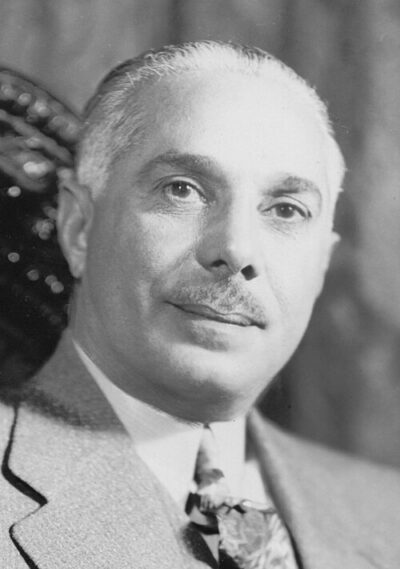
Rafael Trujillo
Rafael Trujillo was a President of the Dominican Republic. Born October 24, 1891, in San Cristóbal. Died May 30, 1961, in Haina. Positions held include President of the Dominican Republic (2 times) (1930–1952) and president. Awards include Collar of the Order of Isabella the Catholic, Order of Merit of Duarte, Sanchez and Mella and Knight Grand Cross of the Order of St. Gregory the Great.
Facts
40 facts · 2 confirmed by two sources · 9 cited · 29 from one source
Where this comes from
Papalocal keeps its own record. It started from these sources; what each one said is kept here as it was copied, so a change on their side never changes this page by itself. Tap one to read its version.
What Wikidata says · copied November 16, 2026 · revision 2563045562
- Described as
- President of the Dominican Republic (1891-1961)
- Other names
- Rafael L. Trujillo, Rafael Leónidas Trujillo, Rafael Leónidas Trujillo Molina
- Born
- October 24, 1891 · 11 references
- Died
- May 30, 1961 · 9 references
- Born in
- San Cristóbal · 1 reference
- Died in
- Haina · 1 reference
- Buried in
- Mingorrubio Cemetery (2005–) · 1 reference
- Cause of death
- gunshot wound
- Name at birth
- Rafael Leónidas Trujillo Molina
- Citizen of
- Dominican Republic
- Occupation
- politician · 1 reference; military officer; dictator
- Positions held
- President of the Dominican Republic (2 times) (1930–1952); president · 1 reference
- Political party
- Dominican Party
- Awards
- Collar of the Order of Isabella the Catholic (1954) · 1 reference; Order of Merit of Duarte, Sanchez and Mella; Knight Grand Cross of the Order of St. Gregory the Great; Knight in the Order of the Holy Sepulchre; Grand Cross of the Legion of Honour; Grand Cross of the Civil Order of Alfonso X the Wise (1957) · 1 reference; commander of the Order of the Crown of Italy; Grand Cross of the Order of Charles III (1947) · 1 reference; Grand Cross of the Order of the Condor of the Andes; Grand Cross of the Order of the Southern Cross; Knight Grand Cross in the Order of the Netherlands Lion; Order of Francisco Morazán; Grand Cross Special Class of the Order of Merit of the Federal Republic of Germany; Collar of the Supreme Order of the Chrysanthemum; Knight Grand Cross with Collar of the Order of Merit of the Italian Republic (1954) · 1 reference
- Children
- Ramfis Trujillo; Angelita Trujillo · 1 reference; Flor de Oro Trujillo
- Father
- José Trujillo Valdéz · 1 reference
- Mother
- Altagracia Julia Molina Chevalier · 1 reference
- Siblings
- Héctor Trujillo
- Religion
- Catholicism
- Military branch
- Dominican Army · 1 reference; Dominican National Police
- Military rank
- generalissimo · 1 reference; general · 1 reference
- Wikipedias with a page
- 63
Wikidata item Q152474 (wikidata.org/wiki/Q152474), public domain (CC0). Copied November 16, 2026.
What Wikipedia says · copied November 16, 2026 · revision 1380588121
Rafael Leónidas Trujillo Molina ( troo-HEE-yoh; Spanish: [rafaˈel tɾuˈxiʝo]; 24 October 1891 – 30 May 1961), nicknamed "El Jefe" (Spanish: [el ˈxefe]; lit. 'The Boss'), was a Dominican military officer and dictator who ruled the Dominican Republic from August 1930 until his assassination in May 1961. He was the country's 36th and 39th president, from 1930 to 1938 and from 1942 to 1952 respectively. He was also the country's first generalissimo, its de facto most powerful position at the time, from 1930 until his assassination. In that position, Trujillo ruled the country under figurehead presidents.
Trujillo's 31-year rule, known as the Age of Trujillo (Spanish: El Trujillato or La Era de Trujillo), was one of the longest for a non-royal leader in the world, and centered around a personality cult of the ruling family. It was also one of the most brutal; Trujillo's security forces, including the infamous SIM, were responsible for many murders. Estimates for the number of deaths in the Dominican Republic under Trujillo's regime range from 25,000 deaths and disappearances to over 50,000 deaths. In 1937, 17,000 to 35,000 Haitians were killed by the Dominican Army under Trujillo's orders in the infamous Parsley massacre, which continues to affect Dominican-Haitian relations.
During his long rule, the Trujillo government's extensive use of state terrorism was prolific even beyond national borders, including the attempted assassination of Venezuelan president Rómulo Betancourt in 1960, the abduction and disappearance in New York City of the Basque exile Jesús Galíndez in 1956, and the murder of Spanish writer José Almoina in Mexico, also in 1960. These acts, particularly the presumed murder of Galíndez, a naturalized US citizen, the attempted murder of Betancourt, a staunch critic of Trujillo, and the murder of the Mirabal sisters, who were among his most notable opponents, in 1960, eroded relations between the Dominican Republic and the international community and ushered in OAS sanctions and economic and military assistance to Dominican opposition forces. After this momentous year, large segments of the Dominican establishment, including the military, turned against him.
On 30 May 1961, Trujillo was assassinated by a group of conspirators led by general Antonio Imbert Barrera. In the immediate aftermath, Trujillo's son Ramfis took temporary control of the country, executing most of the conspirators. By November 1961, the Trujillo family was pressured into exile by the titular president Joaquín Balaguer, who introduced reforms to open up the regime. The murder ushered in civil strife which concluded with the Dominican Civil War and a US-OAS intervention. The Dominican Republic eventually stabilised under a multi-party system in 1966.
The Trujillo era unfolded in the Dominican Republic when the Caribbean was particularly susceptible to dictators. In the countries of the Caribbean Basin alone, his dictatorship overlapped with those in Cuba, Nicaragua, Guatemala, El Salvador, Honduras, Venezuela and Haiti. In perspective, the Trujillo dictatorship has been judged more prominent and more brutal than its contemporaries. Trujillo remains a polarizing figure in the Dominican Republic, as the sheer longevity of his rule makes a detached evaluation difficult. While his supporters credit him for bringing long-term stability, economic growth and prosperity, doubling life expectancy of average Dominicans and multiplying the GDP, critics denounce the heavy-handed and violent nature of his regime, including the murder of tens of thousands, and xenophobia towards Haitians, as well as the Trujillo family's nepotism, widespread corruption and looting of the country's natural and economic resources.
- Born, in its opening lines
- October 24, 1891
- Died, in its opening lines
- May 30, 1961
From the Wikipedia article “Rafael Trujillo” (en.wikipedia.org/wiki/Rafael_Trujillo), by its contributors, under CC BY-SA 4.0 (creativecommons.org/licenses/by-sa/4.0/). Copied November 16, 2026; not changed.
Confirmed Two sources agree. Cited One source, and it names where it got it. One source One source, without a reference of its own. Sources disagree The sources disagree. We show the best-supported value and keep theirs below.
