
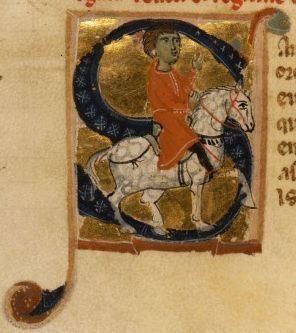
Raimbaut de Vaqueiras
Raimbaut de Vaqueiras was an Occitan poet. Born 1155, in Vacqueyras. Died September 4, 1207, in Rhodope Mountains. Known for Lyrical poems.
Facts
10 facts · 1 confirmed by two sources · 2 cited · 6 from one source · 1 where the sources disagree
What’s different
- Born: we show 1155 (Sources disagree). Wikipedia says 1180
Where this comes from
Papalocal keeps its own record. It started from these sources; what each one said is kept here as it was copied, so a change on their side never changes this page by itself. Tap one to read its version.
What Wikidata says · copied November 17, 2026 · revision 2563181336
- Described as
- Occitan poet
- Other names
- Raimbaut de Vaiqueras
- Born
- 1155 · 1 reference
- Died
- September 4, 1207
- Born in
- Vacqueyras
- Died in
- Rhodope Mountains
- Citizen of
- Kingdom of France
- Occupation
- composer · 1 reference; troubadour · 1 reference; poet
- Known for
- Lyrical poems
- Field
- Occitan culture
- Wikipedias with a page
- 27
Wikidata item Q356509 (wikidata.org/wiki/Q356509), public domain (CC0). Copied November 17, 2026.
What Wikipedia says · copied November 17, 2026 · revision 1343571871
Raimbaut de Vaqueiras or Vaqueyras (fl. 1180 – 1207) was a Provençal troubadour and, later in his life, knight. His life was spent mainly in Italian courts until 1203, when he joined the Fourth Crusade. His writings, particularly the so-called Epic Letter, form an important commentary on the politics of the Latin Empire in its earliest years. Vaqueiras's works include a multilingual poem, Eras quan vey verdeyar where he used French, Tuscan, Galician-Portuguese and Gascon, together with his own Provençal.
Vaqueiras was from Vacqueyras, near Orange. He spent most of his career as court poet and close friend of Boniface I of Montferrat, with whom he served in battle against the communes of Asti and Alessandria. Vaqueiras claimed he earned a knighthood through protecting Boniface with his shield in battle at Messina, when they took part in Emperor Henry VI's invasion of Sicily. He was present at the siege and capture of Constantinople in 1204, and then accompanied Boniface to Thessalonica. It is generally presumed that Raimbaut died on 4 September 1207, together with Boniface, in an ambush by the Vlach.
The only critical edition of Vaqueiras attributes 33 extant songs to him; only eight of the associate melodies have survived. He used a wide range of styles, including a descort, several cansos and tensos, an alba and a gap; he, with Perdigon and Ademar de Peiteus, invented the torneyamen (or, at least, left us its earliest example). One of his songs, "Kalenda Maia", is referred to as an estampida and is considered one of the best troubadour melodies. However, according to the razó, he borrowed the tune from two other musicians. This would explain why the song is called an estampida, which is, theoretically, a purely instrumental piece.
- Born, in its opening lines
- 1180
- Died, in its opening lines
- 1207
From the Wikipedia article “Raimbaut de Vaqueiras” (en.wikipedia.org/wiki/Raimbaut_de_Vaqueiras), by its contributors, under CC BY-SA 4.0 (creativecommons.org/licenses/by-sa/4.0/). Copied November 17, 2026; not changed.
Confirmed Two sources agree. Cited One source, and it names where it got it. One source One source, without a reference of its own. Sources disagree The sources disagree. We show the best-supported value and keep theirs below.
