
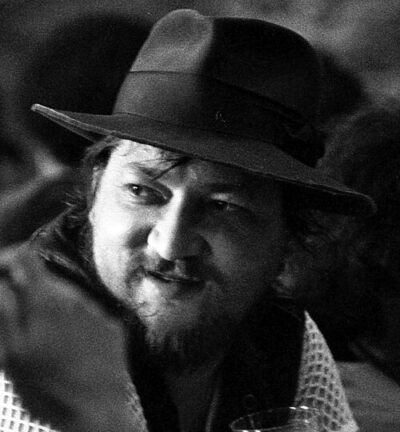
Rainer Werner Fassbinder
Rainer Werner Fassbinder was a German filmmaker, playwright and actor. Born May 31, 1945, in Bad Wörishofen. Died June 10, 1982, in Munich. Known for Anarchy in Bavaria. Awards include German Film Award for Best Screenplay, German Film Award for Best Direction (3 times) and German Film Award for Best Feature Film.
Facts
33 facts · 2 confirmed by two sources · 8 cited · 22 from one source · 1 where the sources disagree
What’s different
- Cause of death: we show cardiac arrest (Sources disagree). Wikidata also lists barbiturate overdose
Where this comes from
Papalocal keeps its own record. It started from these sources; what each one said is kept here as it was copied, so a change on their side never changes this page by itself. Tap one to read its version.
What Wikidata says · copied November 16, 2026 · revision 2570105447
- Described as
- German filmmaker, playwright and actor (1945-1982)
- Other names
- R. W. Fassbinder, Rajner Verner Fasbinder, Raïner Berner Phasmpinter, Franz Walsch, Rainer W. Fassbinder, Franz Walsh, Rainer-Werner Fassbinder
- Born
- May 31, 1945 · 15 references
- Died
- June 10, 1982 · 16 references
- Born in
- Bad Wörishofen · 1 reference
- Died in
- Munich · 4 references
- Buried in
- Bogenhausener Friedhof
- Cause of death
- cardiac arrest; barbiturate overdose
- Citizen of
- American occupation zone in Germany; Bizone; Trizone; West Germany
- Occupation
- screenwriter · 3 references; playwright; film director; actor · 2 references; film editor; television director; cinematographer · 2 references; film producer · 2 references
- Worked for
- Bruno Jori · 1 reference
- Genre
- New German Cinema
- Known for
- Anarchy in Bavaria
- Awards
- German Film Award for Best Screenplay (1970); German Film Award for Best Direction (3 times) (1971, 1978, 1979); German Film Award for Best Feature Film (1972); Sutherland Trophy (1974); David di Donatello Luchino Visconti (1979); Golden Bear (1982); Gerhart Hauptmann Prize (1969); Grimme-Preis (1974)
- Spouse
- Ingrid Caven (1970–1972); Juliane Lorenz · 1 reference
- Mother
- Liselotte Eder · 1 reference
- Lived in
- Munich
- Wikipedias with a page
- 62
Wikidata item Q44426 (wikidata.org/wiki/Q44426), public domain (CC0). Copied November 16, 2026.
What Wikipedia says · copied November 16, 2026 · revision 1381425510
Rainer Werner Fassbinder (German: [ˈʁaɪnɐ ˈvɛʁnɐ ˈfasbɪndɐ] ; 31 May 1945 – 10 June 1982), sometimes credited as R. W. Fassbinder, was a German filmmaker, dramatist and actor. He is widely regarded as one of the major figures and catalysts of the New German Cinema movement. He directed over 40 films that span a variety of genres; frequently his work blends elements of Hollywood melodrama with social criticism and avant-garde techniques. His films, according to him, explored "the exploitability of feelings". His work was deeply rooted in post-war German culture: the aftermath of Nazism, the German economic miracle and the Red Army Faction. Early on, Fassbinder focused on marginalized figures in the city—migrant workers, prisoners, and gay people. He worked with a company of actors and technicians who frequently appeared in his projects.
Fassbinder began leading the acting troupe Anti-Theater in 1967, with whom he staged some of his earliest productions. His first feature-length film was a gangster movie called Love Is Colder Than Death (1969); he scored his first domestic commercial success with The Merchant of Four Seasons (1972) and his first international success with Ali: Fear Eats the Soul (1974), both of which are considered masterpieces by contemporary critics. Big-budget projects such as Despair (1978), Lili Marleen and Lola (both 1981) followed. His greatest success came with The Marriage of Maria Braun (1979), chronicling the rise and fall of a German woman in the wake of World War II. Other notable films include the lesbian chamber drama The Bitter Tears of Petra von Kant (1972), Fox and His Friends (1975), Satan's Brew (1976), In a Year of 13 Moons (1978) and Querelle (1982), all of which dealt with homoerotic themes. He also directed the TV series World on a Wire (1973) and Berlin Alexanderplatz (1980).
Fassbinder died on 10 June 1982, aged 37, from a lethal cocktail of cocaine and barbiturates. His career lasted less than two decades, but he was extremely prolific; between 1967 and 1982, he completed over 40 feature films, 24 plays, two television serials, three short films and four video productions, winning five of the most prestigious prizes for feature film in Germany, including the Golden Bear and multiple German Film Awards. His premature death is often considered the end of the New German Cinema timeframe.
- Born, in its opening lines
- May 31, 1945
- Died, in its opening lines
- June 10, 1982
From the Wikipedia article “Rainer Werner Fassbinder” (en.wikipedia.org/wiki/Rainer_Werner_Fassbinder), by its contributors, under CC BY-SA 4.0 (creativecommons.org/licenses/by-sa/4.0/). Copied November 16, 2026; not changed.
Confirmed Two sources agree. Cited One source, and it names where it got it. One source One source, without a reference of its own. Sources disagree The sources disagree. We show the best-supported value and keep theirs below.
