
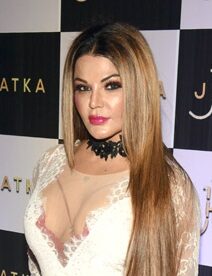
Rakhi Sawant is an Indian actress. Born November 25, 1978, in Worli. Educated at Mithibai College.
Facts
14 facts · 1 confirmed by two sources · 4 cited · 9 from one source
Where this comes from
Papalocal keeps its own record. It started from these sources; what each one said is kept here as it was copied, so a change on their side never changes this page by itself. Tap one to read its version.
What Wikidata says · copied November 17, 2026 · revision 2564400159
- Described as
- Indian actress
- Other names
- Neeru Bheda, Fatima Durrani, Fatima Rakhi Sawant
- Born
- November 25, 1978 · 1 reference
- Born in
- Worli · 1 reference
- Citizen of
- India · 1 reference
- Occupation
- model; film actor; dancer; television presenter; television actor; film director · 1 reference; politician · 1 reference
- Political party
- Republican Party of India (A); Rashtriya Aam Party · 1 reference
- Education
- Mithibai College
- Religion
- Islam
- Wikipedias with a page
- 25
Wikidata item Q3543017 (wikidata.org/wiki/Q3543017), public domain (CC0). Copied November 17, 2026.
What Wikipedia says · copied November 17, 2026 · revision 1383230619
Rakhi Sawant (born Neeru Bheda; 25 November 1978) is an Indian media personality, actress, dancer and politician. She has performed item numbers predominantly in Hindi films. Her notable film appearances have been in Chura Liyaa Hai Tumne (2003), Masti (2004), Main Hoon Na (2004), Krazzy 4 (2008), and Dil Bole Hadippa! (2008).
Sawant was a contestant on the first season of the reality television series Bigg Boss 1 (2006) and a challenger and finalist in Bigg Boss 14 (2020). Sawant has established herself as a sex symbol and has gained attention in the media for her controversial statements and lifestyle.
- Born, in its opening lines
- November 25, 1978
From the Wikipedia article “Rakhi Sawant” (en.wikipedia.org/wiki/Rakhi_Sawant), by its contributors, under CC BY-SA 4.0 (creativecommons.org/licenses/by-sa/4.0/). Copied November 17, 2026; not changed.
Confirmed Two sources agree. Cited One source, and it names where it got it. One source One source, without a reference of its own. Sources disagree The sources disagree. We show the best-supported value and keep theirs below.
