
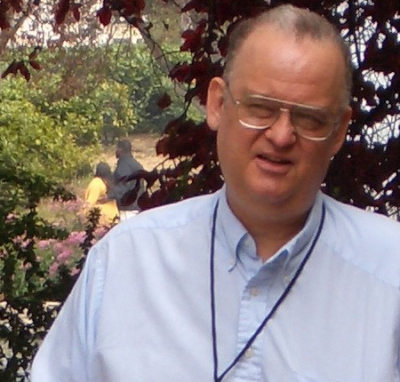
Ralph Merkle
Ralph Merkle is an American cryptographer and cryonicist. Born February 2, 1952, in Berkeley. Educated at University of California, Berkeley and Stanford University. Awards include Paris Kanellakis Award, National Inventors Hall of Fame and Computer History Museum Fellow.
Facts
22 facts · 1 confirmed by two sources · 7 cited · 14 from one source
Where this comes from
Papalocal keeps its own record. It started from these sources; what each one said is kept here as it was copied, so a change on their side never changes this page by itself. Tap one to read its version.
What Wikidata says · copied November 16, 2026 · revision 2569006834
- Described as
- American cryptographer and cryonicist (born 1952)
- Other names
- Ralph Charles Merkle, Ralph C. Merkle
- Born
- February 2, 1952 · 2 references
- Born in
- Berkeley
- Citizen of
- United States
- Occupation
- cryptographer · 1 reference; mathematician; computer scientist; inventor · 1 reference
- Worked for
- Georgia Tech
- Education
- University of California, Berkeley; Stanford University · 1 reference; Livermore High School · 1 reference
- Awards
- Paris Kanellakis Award (1996) · 1 reference; National Inventors Hall of Fame (2011) · 1 reference; Computer History Museum Fellow; IEEE Richard W. Hamming Medal (2010) · 1 reference; National Cyber Security Hall of Fame (2012); IACR Fellow (2008) · 1 reference; Feynman Prize in Nanotechnology (1998); IEEE Koji Kobayashi Computers and Communications Award (1999) · 1 reference
- Field
- cryptography · 1 reference
- Spouse
- Carol Shaw
- Website
- https://www.ralphmerkle.com/
- Wikipedias with a page
- 20
Wikidata item Q92884 (wikidata.org/wiki/Q92884), public domain (CC0). Copied November 16, 2026.
What Wikipedia says · copied November 16, 2026 · revision 1371986446
Ralph C. Merkle (born February 2, 1952) is an American computer scientist and mathematician. He is one of the inventors of public-key cryptography, the inventor of cryptographic hashing, and more recently a researcher and speaker on cryonics.
Merkle is a renowned cryptographer, known for devising Merkle's Puzzles, co-inventing the Merkle–Hellman knapsack cryptosystem, and inventing cryptographic hashing (Merkle–Damgård construction) and Merkle trees. He has worked as a manager at Elxsi, research scientist at Xerox PARC (Palo Alto Research Center), and a nanotechnology theorist at Zyvex. Merkle has held positions as a Distinguished Professor at Georgia Tech, senior research fellow at IMM, faculty member at Singularity University, and board member at Alcor Life Extension Foundation. He received the IEEE Richard W. Hamming Medal in 2010 and has published works on molecular manipulation and self-replicating machines. Ralph Merkle is a grandnephew of baseball star Fred Merkle and is married to video game designer Carol Shaw. He serves on the board of directors of the cryonics organization Alcor Life Extension Foundation and appears in the science fiction novel The Diamond Age.
- Born, in its opening lines
- February 2, 1952
From the Wikipedia article “Ralph Merkle” (en.wikipedia.org/wiki/Ralph_Merkle), by its contributors, under CC BY-SA 4.0 (creativecommons.org/licenses/by-sa/4.0/). Copied November 16, 2026; not changed.
Confirmed Two sources agree. Cited One source, and it names where it got it. One source One source, without a reference of its own. Sources disagree The sources disagree. We show the best-supported value and keep theirs below.
