
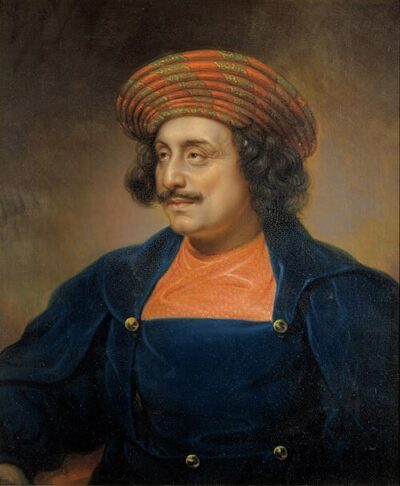
Ram Mohan Roy
Ram Mohan Roy was an Indian religious, social, and educational reformer, and humanitarian. Born May 22, 1772, in Radhanagore. Died September 27, 1833, in Bristol.
Facts
12 facts · 2 confirmed by two sources · 4 cited · 4 from one source · 2 where the sources disagree
What’s different
- Died in: we show Bristol (Sources disagree). Wikidata also lists Purdown Hospital, Beech House
- Buried in: we show Arnos Vale Cemetery (Sources disagree). Wikidata also lists Tomb Of Raja Rammohun Roy Bahadoor, Arnos Vale Cemetery
Where this comes from
Papalocal keeps its own record. It started from these sources; what each one said is kept here as it was copied, so a change on their side never changes this page by itself. Tap one to read its version.
What Wikidata says · copied November 16, 2026 · revision 2562932543
- Described as
- Indian religious, social, and educational reformer, and humanitarian
- Other names
- Rammohun Roy, Rammohan Roy
- Born
- May 22, 1772 · 4 references
- Died
- September 27, 1833 · 6 references
- Born in
- Radhanagore · 1 reference
- Died in
- Bristol · 2 references; Purdown Hospital, Beech House
- Buried in
- Arnos Vale Cemetery; Tomb Of Raja Rammohun Roy Bahadoor, Arnos Vale Cemetery
- Cause of death
- fever · 1 reference
- Citizen of
- Company rule in India · 1 reference
- Occupation
- philosopher; social reformer; writer · 1 reference; translator · 1 reference
- Religion
- Brahmo Samaj · 1 reference
- Wikipedias with a page
- 65
Wikidata item Q335269 (wikidata.org/wiki/Q335269), public domain (CC0). Copied November 16, 2026.
What Wikipedia says · copied November 16, 2026 · revision 1382740851
Raja Ram Mohan Roy (Bengali pronunciation: [ram moɦɔn rae̯]; 22 May 1772 – 27 September 1833) was an Indian social reformer and writer who was one of the founders of the Brahmo Sabha in 1828, the precursor of the Brahmo Samaj, a socio-religious reform movement in the Indian subcontinent. He has been dubbed the "Father of the Indian Renaissance." He was given the title of Raja by Mughal emperor Akbar II (r. 1806–1837).
His influence was apparent in the fields of politics, public administration, education, and religion. He was known for his efforts to abolish the practices of sati and child marriage. Roy wrote Gaudiya Vyakaran, which was the first complete Bangla grammar written book.
- Born, in its opening lines
- May 22, 1772
- Died, in its opening lines
- September 27, 1833
From the Wikipedia article “Raja Ram Mohan Roy” (en.wikipedia.org/wiki/Raja_Ram_Mohan_Roy), by its contributors, under CC BY-SA 4.0 (creativecommons.org/licenses/by-sa/4.0/). Copied November 16, 2026; not changed.
Confirmed Two sources agree. Cited One source, and it names where it got it. One source One source, without a reference of its own. Sources disagree The sources disagree. We show the best-supported value and keep theirs below.
