
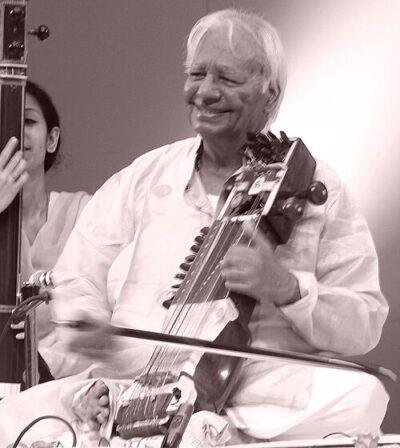
Ram Narayan
Ram Narayan was an Indian classical sarangi player. Born December 25, 1927, in Udaipur. Died November 9, 2024, in Bandra. Awards include Padma Vibhushan, Padma Bhushan and Padma Shri in Art.
Facts
24 facts · 2 confirmed by two sources · 5 cited · 17 from one source
Where this comes from
Papalocal keeps its own record. It started from these sources; what each one said is kept here as it was copied, so a change on their side never changes this page by itself. Tap one to read its version.
What Wikidata says · copied November 16, 2026 · revision 2563962581
- Described as
- Indian classical sarangi player (1927–2024)
- Other names
- Pandit Ramnarayan
- Born
- December 25, 1927 · 1 reference
- Died
- November 9, 2024 · 1 reference
- Born in
- Udaipur
- Died in
- Bandra
- Citizen of
- British Raj (1927–1947); India (1947–2024)
- Occupation
- musician · 1 reference; composer · 1 reference
- Genre
- Indian classical music · 1 reference; Hindustani classical music
- Instrument
- sarangi
- Record label
- EMI
- Awards
- Padma Vibhushan; Padma Bhushan; Padma Shri in Art; Sangeet Natak Akademi Award; Pandit Bhimsen Joshi Lifetime Achievement Award (2015) · 1 reference
- Field
- music · 1 reference; individual double-skin hourglass-shaped drums, both heads played · 1 reference; sarangi · 1 reference
- Children
- Brij Narayan; Aruna Narayan
- Siblings
- Chatur Lal
- Religion
- Hinduism
- Wikipedias with a page
- 81
Wikidata item Q41074 (wikidata.org/wiki/Q41074), public domain (CC0). Copied November 16, 2026.
What Wikipedia says · copied November 16, 2026 · revision 1384034384
Ram Narayan (IPA: [raːm naːˈɾaːjəɳ]; 25 December 1927 – 9 November 2024) often referred to with the title Pandit, was an Indian musician who popularised the bowed instrument sarangi as a solo concert instrument in Hindustani classical music and became the first internationally successful sarangi player.
Narayan was born near Udaipur and learned to play the sarangi at an early age. He studied under sarangi players and singers and, as a teenager, worked as a music teacher and travelling musician. All India Radio in Lahore hired Narayan as an accompanist for vocalists in 1944. Narayan relocated to Delhi following the partition of India in 1947, and moved to Mumbai in 1949 to work in Indian cinema.
Narayan became a concert solo artist in 1956, performing at major music festivals across India. He recorded solo albums and made his first international tour in 1964 to America and Europe with his older brother Chatur Lal, a tabla (hand drum) player who had toured with Ravi Shankar in the 1950s. He was awarded India's second highest civilian honour, the Padma Vibhushan, in 2005.
- Born, in its opening lines
- December 25, 1927
- Died, in its opening lines
- November 9, 2024
From the Wikipedia article “Ram Narayan” (en.wikipedia.org/wiki/Ram_Narayan), by its contributors, under CC BY-SA 4.0 (creativecommons.org/licenses/by-sa/4.0/). Copied November 16, 2026; not changed.
Confirmed Two sources agree. Cited One source, and it names where it got it. One source One source, without a reference of its own. Sources disagree The sources disagree. We show the best-supported value and keep theirs below.
