
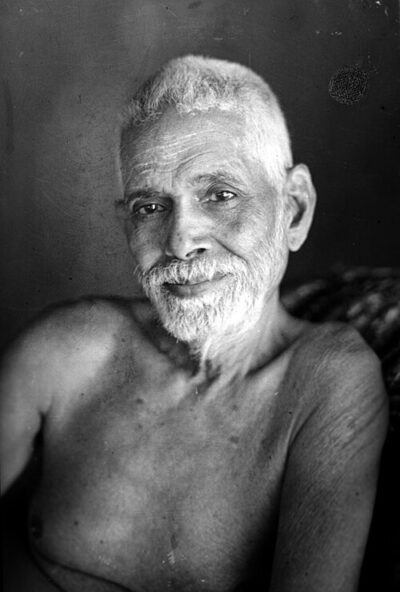
Ramana Maharshi
Ramana Maharshi was an Indian spiritual teacher. Born December 30, 1879, in Tiruchuli Assembly constituency. Died April 14, 1950, in Sri Ramana Ashram.
Facts
16 facts · 2 confirmed by two sources · 3 cited · 11 from one source
What’s different
- Died: we show April 14, 1950 (Confirmed). Wikidata also lists 1922
Where this comes from
Papalocal keeps its own record. It started from these sources; what each one said is kept here as it was copied, so a change on their side never changes this page by itself. Tap one to read its version.
What Wikidata says · copied November 16, 2026 · revision 2564487885
- Described as
- Indian spiritual teacher (1879–1950)
- Other names
- ramanulu
- Born
- December 30, 1879 · 6 references
- Died
- April 14, 1950 · 6 references; 1922 · 1 reference
- Born in
- Tiruchuli Assembly constituency
- Died in
- Sri Ramana Ashram
- Cause of death
- cancer
- Name at birth
- இரமண மகரிசி
- Citizen of
- India (1950–); British Raj (–1947); Dominion of India (1947–1950)
- Occupation
- philosopher; writer · 1 reference; yogi · 1 reference
- Field
- religion · 1 reference; Hinduism · 1 reference
- Religion
- Advaita Vedanta; Neo-Vedanta
- Wikipedias with a page
- 77
Wikidata item Q288441 (wikidata.org/wiki/Q288441), public domain (CC0). Copied November 16, 2026.
What Wikipedia says · copied November 16, 2026 · revision 1376801889
Ramana Maharshi (pronounced [ˈɾɐ.mɐ.ɳɐ mɐˈɦɐɾ.ʂi] ; 30 December 1879 – 14 April 1950) was an Indian Hindu sage widely regarded by his followers and by "most advocates of Advaita" as a jivanmukta (liberated being). He was born Venkataraman Iyer, but is mostly known by the name Bhagavan Sri Ramana Maharshi.
He was born in Tiruchuli, Tamil Nadu, India in 1879. In 1895, an attraction to the sacred hill Arunachala and the 63 Nayanmars was aroused in him, and in 1896, at the age of 16, he had a "death-experience" in which he became aware of a "current" or "force" (avesam) which he recognised as his true "I" or "self", and which he later identified with "the personal God, or Iswara", that is, Shiva. This resulted in a state that he later described as "the state of mind of Iswara or the jnani". Six weeks later he left his uncle's home in Madurai, and journeyed to the holy mountain Arunachala, in Tiruvannamalai, where he took on the role of a sannyasin (though not formally initiated), and remained for the rest of his life.
He attracted devotees who regarded him as an avatar of Shiva and came to him for darshan ("the sight of God"). In later years, an ashram grew up around him, where visitors received upadesa ("spiritual instruction") by sitting silently in his company or by asking questions. Since the 1930s his teachings have been popularised in the West.
Ramana Maharshi approved a number of paths and practices, but recommended self-enquiry as the principal means to remove ignorance and abide in self-awareness, together with bhakti (devotion) or surrender to the Self.
- Born, in its opening lines
- December 30, 1879
- Died, in its opening lines
- April 14, 1950
From the Wikipedia article “Ramana Maharshi” (en.wikipedia.org/wiki/Ramana_Maharshi), by its contributors, under CC BY-SA 4.0 (creativecommons.org/licenses/by-sa/4.0/). Copied November 16, 2026; not changed.
Confirmed Two sources agree. Cited One source, and it names where it got it. One source One source, without a reference of its own. Sources disagree The sources disagree. We show the best-supported value and keep theirs below.
