
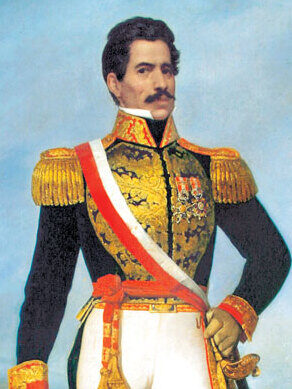
Ramón Castilla
Ramón Castilla was a president of Peru. Born August 31, 1797, in San Lorenzo de Tarapacá. Died May 30, 1867, in Tiliviche. Positions held include President of Peru (1844).
Facts
12 facts · 2 confirmed by two sources · 4 cited · 6 from one source
Where this comes from
Papalocal keeps its own record. It started from these sources; what each one said is kept here as it was copied, so a change on their side never changes this page by itself. Tap one to read its version.
What Wikidata says · copied November 17, 2026 · revision 2567815977
- Described as
- president of Peru (1797-1867)
- Other names
- Ramon Castilla, Ramón Castilla y Marquesado
- Born
- August 31, 1797 · 5 references
- Died
- May 30, 1867 · 6 references
- Born in
- San Lorenzo de Tarapacá · 1 reference
- Died in
- Tiliviche · 1 reference
- Buried in
- Panteón de los Próceres
- Citizen of
- Peru
- Occupation
- politician · 1 reference; military personnel; revolutionary · 1 reference; Generalfeldmarschall · 1 reference
- Positions held
- President of Peru (1844) · 1 reference
- Military rank
- marshal
- Wikipedias with a page
- 26
Wikidata item Q1763351 (wikidata.org/wiki/Q1763351), public domain (CC0). Copied November 17, 2026.
What Wikipedia says · copied November 17, 2026 · revision 1374066052
Ramón Castilla y Marquesado (Spanish pronunciation: [raˈmoŋ kasˈtiʝa] ; 31 August 1797 – 30 May 1867) was a Peruvian caudillo who served twice as President of Peru, first in 1845–1851, and then in 1855–1862. He also led a military junta in 1844, and was de facto interim president for a couple of days in April 1863. His earliest prominent appearance in Peruvian history began with his participation in a commanding role of the army of the Libertadores that helped Peru become an independent nation. Later, he led the country when the economy boomed due to the exploitation of guano deposits. Castilla's governments are remembered for having abolished slavery and modernized the state.
He began his military career in the royalist army, participating in the Battle of Chacabuco. Taken prisoner after the battle, he was taken to Buenos Aires where he obtained permission to leave the country and returned to Peru. Reinstated in the Royal Army of Peru, he joined the independence cause in early 1822. He organized and served in the cavalry of the Peruvian Legion, distinguishing himself at the Battle of Ayacucho. He continued his military and political career, holding high public offices such as sub-prefect of his native Tarapacá and prefect of Puno during the administrations of Agustín Gamarra and Luis José de Orbegoso.
His first constitutional government was notable for the country's institutional stability after a long period of anarchy, the organization of the Peruvian state, and the economic boom fueled by revenues from the guano deposits. He led the liberal revolution of 1854 and decreed the abolition of the indigenous tribute and the end of slavery.
- Born, in its opening lines
- August 31, 1797
- Died, in its opening lines
- May 30, 1867
From the Wikipedia article “Ramón Castilla” (en.wikipedia.org/wiki/Ramón_Castilla), by its contributors, under CC BY-SA 4.0 (creativecommons.org/licenses/by-sa/4.0/). Copied November 17, 2026; not changed.
Confirmed Two sources agree. Cited One source, and it names where it got it. One source One source, without a reference of its own. Sources disagree The sources disagree. We show the best-supported value and keep theirs below.
