
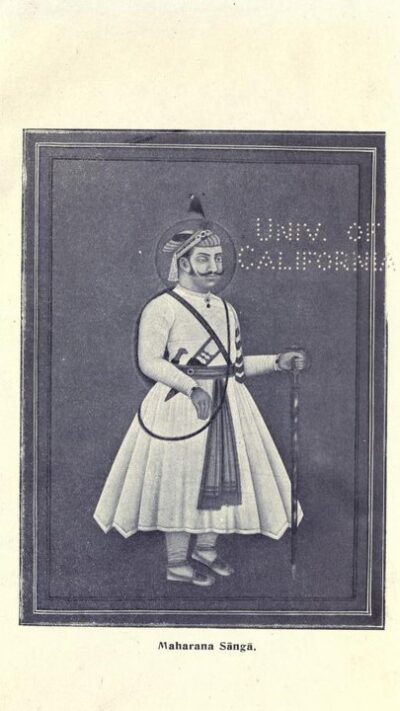
Rana Sanga was a Maharana of Mewar. Born April 12, 1482, in Chittorgarh. Died January 30, 1528, in Kalpi. Positions held include Maharana of Mewar (1508–1528).
Facts
14 facts · 2 confirmed by two sources · 0 cited · 12 from one source
Where this comes from
Papalocal keeps its own record. It started from these sources; what each one said is kept here as it was copied, so a change on their side never changes this page by itself. Tap one to read its version.
What Wikidata says · copied November 18, 2026 · revision 2556159332
- Described as
- Maharana of Mewar
- Other names
- Rana Sangram Singh, Maharana Sangram Singh
- Born
- April 12, 1482 · 1 reference
- Died
- January 30, 1528
- Born in
- Chittorgarh
- Died in
- Kalpi
- Cause of death
- poisoning
- Citizen of
- Kingdom of Mewar
- Positions held
- Maharana of Mewar (1508–1528)
- Spouse
- Rani Karnavati
- Children
- Bhoj Raj · 1 reference; Vikramaditya Singh · 1 reference; Ratan Singh II; Udai Singh II · 1 reference
- Father
- Raimal
- Religion
- Hinduism
- Wikipedias with a page
- 24
Wikidata item Q2590601 (wikidata.org/wiki/Q2590601), public domain (CC0). Copied November 18, 2026.
What Wikipedia says · copied November 18, 2026 · revision 1384266768
Sangram Singh I (Mewari pronunciation: [səŋɡɾaːm sɪ̃ɳ]; 12 April 1482 – 30 January 1528), most commonly known as Rana Sanga, was the Maharana of Mewar from 24 May 1509 until his death in 1528. A member of the Sisodia dynasty, he controlled parts of present-day Rajasthan, Gujarat, Madhya Pradesh, Haryana, Sindh, and Uttar Pradesh from his capital at Chittorgarh.
During his military career, Sanga was successful against several neighbouring sultanates. After the 1519 Battle of Gagron against the Malwa Sultanate, he captured much of eastern Malwa. He humbled the Sultan of Gujarat several times. Sanga also had the Khanzadas of Mewat as vassals, helping them extend their sway over modern-day Haryana. Among his victories were those against the Lodi dynasty of Delhi at Khatoli, Dholpur, and Ranthambore, enabling Sanga to capture much of the Lodi domain in southern Malwa and western Uttar Pradesh.
At its zenith in 1521, Sanga's empire stretched from Mandu (the capital of Malwa Sultanate) in the south to Peela Khal (Pilya Khal, a small rivulet near Bayana and Agra) in the northeast, to the Indus River in the west and north-west. Nearly all the Rajput chiefs owed allegiance to him. Sanga also marched against the invading forces of Babur, who founded the Mughal Empire. Despite initial success against Mughal-Afghan forces at the Battle of Bayana, he experienced a significant defeat at Khanwa (primarily due to Babur's use of gunpowder, unknown in northern India at the time).
Sanga is considered the greatest ruler of his time. Said to have won 18 battles against the sultans of Delhi, Malwa and Gujarat, he is renowned for his heroism and leadership. Sanga received more than 80 wounds in battle; he lost an eye and an arm, and one of his legs was crippled. He is considered the last independent Hindu sovereign of northern India to control extensive territory. His reign was admired by Babur, the first Mughal emperor who described him as the "greatest Indian ruler" of that time; Babur also accused him of sending an invitation to invade India, a claim that has not been widely accepted. Mughal historian Abd al-Qadir Badayuni called Sanga the bravest of all Rajputs with Prithviraj Chauhan, also known as Rai Pithaura.
- Born, in its opening lines
- April 12, 1482
- Died, in its opening lines
- January 30, 1528
From the Wikipedia article “Rana Sanga” (en.wikipedia.org/wiki/Rana_Sanga), by its contributors, under CC BY-SA 4.0 (creativecommons.org/licenses/by-sa/4.0/). Copied November 18, 2026; not changed.
Confirmed Two sources agree. Cited One source, and it names where it got it. One source One source, without a reference of its own. Sources disagree The sources disagree. We show the best-supported value and keep theirs below.
