
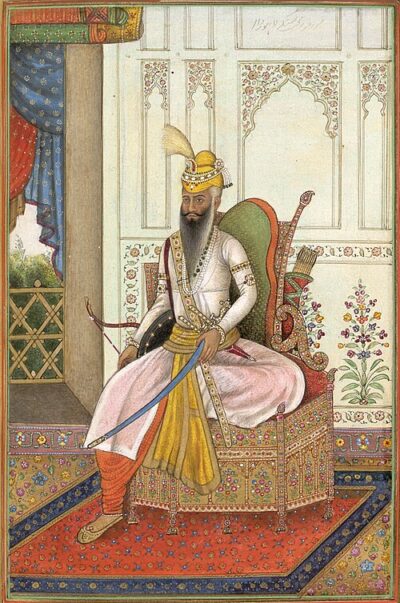
Ranjit Singh
Ranjit Singh was a First Maharaja of the Sikh Empire. Born November 13, 1780, in Gujranwala. Died June 27, 1839, in Lahore. Positions held include Maharaja (1801–1839).
Facts
27 facts · 2 confirmed by two sources · 3 cited · 21 from one source · 1 where the sources disagree
What’s different
- Buried in: we show Samadhi of Ranjit Singh (Sources disagree). Wikidata also lists Lahore
Where this comes from
Papalocal keeps its own record. It started from these sources; what each one said is kept here as it was copied, so a change on their side never changes this page by itself. Tap one to read its version.
What Wikidata says · copied November 16, 2026 · revision 2558221462
- Described as
- First Maharaja of the Sikh Empire (1780–1839)
- Other names
- Maharaja Ranjit Singh, Buddh Singh, Sher-e-Punjab
- Born
- November 13, 1780 · 4 references
- Died
- June 27, 1839 · 4 references
- Born in
- Gujranwala · 2 references
- Died in
- Lahore · 1 reference
- Buried in
- Samadhi of Ranjit Singh; Lahore
- Cause of death
- cerebrovascular disease
- Citizen of
- Sikh Empire
- Occupation
- sovereign · 1 reference
- Positions held
- Maharaja (1801–1839)
- Spouse
- Mahtab Kaur (1796–1839) · 1 reference; Datar Kaur (1792–1838); Jind Kaur (1829–1839); Moran Sarkar; Chand Kaur; Rani Katochan
- Children
- Kharak Singh; Ishar Singh; Rattan Singh; Sher Singh; Tara Singh; Multana Singh; Kashmira Singh; Pashaura Singh; Duleep Singh I
- Father
- Maha Singh
- Mother
- Raj Kaur · 1 reference
- Religion
- Sikhism
- Wikipedias with a page
- 57
Wikidata item Q332620 (wikidata.org/wiki/Q332620), public domain (CC0). Copied November 16, 2026.
What Wikipedia says · copied November 16, 2026 · revision 1384562351
Ranjit Singh (Punjabi pronunciation: [ɾəɳd͡ʒiːt̪(ə̆) sɪ˩˥ŋɡ]; c. 13 November 1780 – 27 June 1839) was the founder and the first maharaja of the Sikh Empire, ruling from 1801 until his death in 1839. Starting as a local chieftain, by the time of his death he had expanded his kingdom from Ladakh in the north to the borders of Sindh, and from Khyber Pass in the west to the river Sutlej in the east.
Ranjit Singh was born to Maha Singh, the leader of the Sukerchakia Misl, and fought his first battle alongside his father at the age of ten. After Maha Singh died during his early teenage years, Ranjit Singh became leader of the misl. He was the most prominent of the Sikh leaders who opposed Zaman Shah, the ruler of Durrani Empire, during his third invasion. After the retreat of Zaman Shah in 1799, he captured Lahore from the Sikh triumvirate which had been ruling the city since 1765. At the age of 21, he was formally crowned at Lahore.
Before his rise, the Punjab had been fragmented into a number of warring Sikh, Muslim, and Hindu states. A large part of Punjab was under direct Durrani control. By 1813, Ranjit Singh had successfully annexed the Sikh misls and taken over the local kingdoms; the following decades saw the conquest of Durrani Afghan-ruled territories of Multan, Kashmir and Peshawar into his expanding Sikh Empire. Ranjit Singh established friendly diplomatic relations with the British after the treaty of Amritsar.
During his reign, Ranjit Singh introduced military reforms, structural changes in administration, and modernisation. His Khalsa army and government included Sikhs, Muslims, Hindus, and Europeans. His legacy includes a period of Sikh cultural and artistic renaissance, including the rebuilding of the Harmandir Sahib in Amritsar as well as other major gurdwaras, such as the Takht Sri Patna Sahib and the Hazur Sahib Nanded under his sponsorship despite being located outside of his realm. Ranjit Singh was succeeded by his son Kharak Singh after his death in 1839.
- Born, in its opening lines
- November 13, 1780
- Died, in its opening lines
- June 27, 1839
From the Wikipedia article “Ranjit Singh” (en.wikipedia.org/wiki/Ranjit_Singh), by its contributors, under CC BY-SA 4.0 (creativecommons.org/licenses/by-sa/4.0/). Copied November 16, 2026; not changed.
Confirmed Two sources agree. Cited One source, and it names where it got it. One source One source, without a reference of its own. Sources disagree The sources disagree. We show the best-supported value and keep theirs below.
