
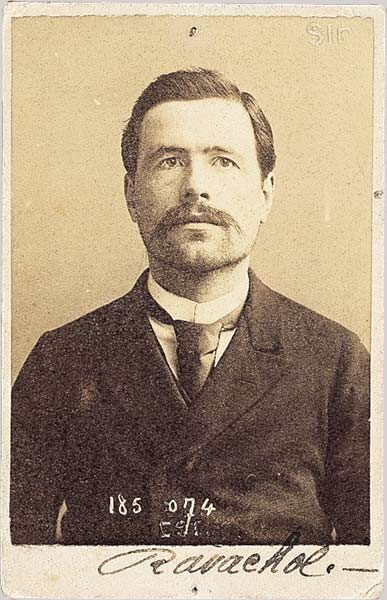
Ravachol
Ravachol was a French anarchist. Born October 14, 1859, in Saint-Chamond. Died July 11, 1892, in Montbrison.
Facts
11 facts · 2 confirmed by two sources · 2 cited · 7 from one source
Where this comes from
Papalocal keeps its own record. It started from these sources; what each one said is kept here as it was copied, so a change on their side never changes this page by itself. Tap one to read its version.
What Wikidata says · copied November 17, 2026 · revision 2530814799
- Described as
- French anarchist (1859-1892)
- Other names
- François Claudius Koënigstein, Francois Claudius Koenigstein
- Born
- October 14, 1859 · 2 references
- Died
- July 11, 1892 · 3 references
- Born in
- Saint-Chamond
- Died in
- Montbrison · 1 reference
- Cause of death
- decapitation
- Citizen of
- France · 1 reference
- Occupation
- activist; accordionist; smuggler; laborer
- Instrument
- accordion
- Wikipedias with a page
- 26
Wikidata item Q558456 (wikidata.org/wiki/Q558456), public domain (CC0). Copied November 17, 2026.
What Wikipedia says · copied November 17, 2026 · revision 1365856154
François Claudius Ravachol (French: [ʁavaʃɔl]; born Koenigstein; 14 October 1859 – 11 July 1892), also known as the Christ of Anarchy, was a French illegalist anarchist mainly known for his terrorist activism, impact, the myths that developed around his figure, and his influence on the anarchist movement, French society and art. He is also credited as being one of the main launchers of the Ère des attentats (1892-1894).
Born in 1859 in Saint-Chamond, in the Saint-Étienne area, Ravachol grew up in poverty and domestic violence. Later, he began a life of crime marked by the murder and robbery of a rich hermit. In this city, Ravachol gradually adopted anarchist ideas and met other activists, such as Rosalie Soubère and Joseph Jas-Béala. He managed to escape from arrest, and with these two accomplices, the militant moved to Paris in 1891. There, joined by the young anarchist militant Charles Simon, Clotilde Mabillon, her husband Chaumartin and maybe Gustave Mathieu, they carried out the Saint-Germain and Clichy bombings, targeting the judge and prosecutor responsible for the judicial persecution of anarchists arrested during the Clichy affair (1891).
Quickly arrested after the second attack, he stood trial, took full responsibility for the bombings in an effort to protect his companions, and was sentenced to life imprisonment with mitigating circumstances granted by the jury. Later, he was tried for the hermit’s murder and condemned to death, ultimately being guillotined on 11 July 1892, at Montbrison.
Although he was swiftly captured, arrested, and executed shortly after his attacks, which caused no fatalities, Ravachol is widely regarded as one of the launchers of the Ère des attentats, a wave of anarchist terrorism from 1892 to 1894. His assumption of full responsibility, efforts to exonerate his companions, and transformation from criminal to "people's avenger" in a sense, made him a martyr for anarchists and a folk hero within the French population. He also became the cultural archetype of the "anarchist terrorist". Ravachol's actions also marked a turning point in the evolution of terrorism; he was one of the first terrorists to move away from a symbolism centered on individuals and toward one centered on locations, targeting a place as much as a person, in his case. This aspect has become important in modern terrorism but was little understood by the contemporary press, which failed to grasp the motivations behind his actions.
Since then, he has become the avatar of numerous cultural adaptations, being variously portrayed in art and media as a vigilante acting to save humanity, a rebel without morals, or in more ironic and satirical takes that use his image to mock the authorities and the wealthy, as seen in traditional Parisian songs.
- Born, in its opening lines
- October 14, 1859
- Died, in its opening lines
- July 11, 1892
From the Wikipedia article “Ravachol” (en.wikipedia.org/wiki/Ravachol), by its contributors, under CC BY-SA 4.0 (creativecommons.org/licenses/by-sa/4.0/). Copied November 17, 2026; not changed.
Confirmed Two sources agree. Cited One source, and it names where it got it. One source One source, without a reference of its own. Sources disagree The sources disagree. We show the best-supported value and keep theirs below.
