
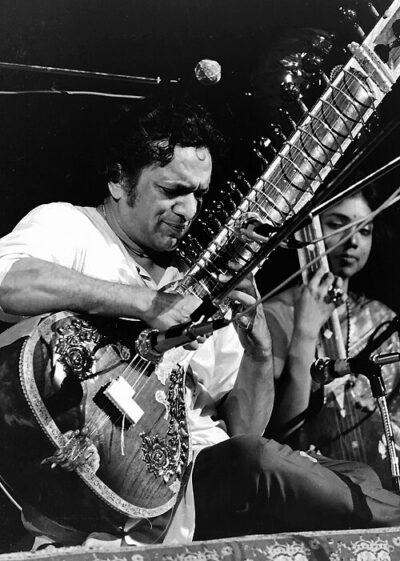
Ravi Shankar
Ravi Shankar was an Indian sitar player. Born April 7, 1920, in Varanasi. Died December 11, 2012, in San Diego. Positions held include member of Rajya Sabha. Awards include Commandeur des Arts et des Lettres, Knight Commander of the Order of the British Empire and Ramon Magsaysay Award.
Facts
49 facts · 2 confirmed by two sources · 10 cited · 36 from one source · 1 where the sources disagree
What’s different
- Cause of death: we show respiratory failure (Sources disagree). Wikidata also lists heart failure
Where this comes from
Papalocal keeps its own record. It started from these sources; what each one said is kept here as it was copied, so a change on their side never changes this page by itself. Tap one to read its version.
What Wikidata says · copied November 16, 2026 · revision 2569901053
- Described as
- Indian sitar player (1920–2012)
- Other names
- Pandit Ravi Shankar, Robindro Shaunkor Chowdhury
- Born
- April 7, 1920 · 10 references
- Died
- December 11, 2012 · 9 references
- Born in
- Varanasi · 3 references
- Died in
- San Diego · 2 references
- Cause of death
- respiratory failure; heart failure
- Citizen of
- British Raj (–1947); India (1950–) · 1 reference
- Occupation
- composer · 1 reference; sitarist; film director · 2 references; politician; conductor · 1 reference; singer · 1 reference; musician · 1 reference
- Positions held
- member of Rajya Sabha
- Member of
- American Academy of Arts and Letters
- Genre
- Hindustani classical music; Indian classical music · 1 reference
- Instrument
- sitar
- Record label
- His Master's Voice; Private Music; Apple Records; Dark Horse Records; Deutsche Grammophon; Pacific Jazz Records
- Awards
- Commandeur des Arts et des Lettres; Knight Commander of the Order of the British Empire; Ramon Magsaysay Award (1992); Grammy Lifetime Achievement Award (2013); Banga Bibhushan; Praemium Imperiale (1997) · 1 reference; James Parks Morton Interfaith Award; Sangeet Natak Akademi Award (1962); Padma Bhushan in Art (1967); Grammy Award for Best Chamber Music Performance (1967); Grammy Award for Album of the Year (1972); Polar Music Prize (1998); Bharat Ratna (1999) · 1 reference; Grammy Award for Best Global Music Album (2001); Tagore Award (2012)
- Spouse
- Annapurna Devi (1941–1961)
- Children
- Norah Jones; Shubbo Shankar; Anoushka Shankar
- Siblings
- Uday Shankar
- Religion
- Hinduism
- Lived in
- Varanasi; Encinitas
- Website
- http://www.ravishankar.org
- Wikipedias with a page
- 96
Wikidata item Q103774 (wikidata.org/wiki/Q103774), public domain (CC0). Copied November 16, 2026.
What Wikipedia says · copied November 16, 2026 · revision 1385943485
Pandit Ravi Shankar (Bengali: [ˈrobi ˈʃɔŋkor]; born Robindro Shaunkor Chowdhury, sometimes spelled as Ravindra Shankar Chowdhury; 7 April 1920 – 11 December 2012) was an Indian sitarist and composer. Ravi Shankar was born in Banaras. A sitar virtuoso, he was, together with sarod virtuoso Ali Akbar Khan, among the most prominent exponents of Hindustani classical music in the second half of the 20th century, and played a major role in bringing Indian classical music to international audiences. Shankar influenced many musicians in India and throughout the world. He was awarded India's highest civilian honour, the Bharat Ratna, in 1999. He is also the father of American singer Norah Jones and British-American musician and sitar player Anoushka Shankar.
Shankar was born to a Bengali family in India, and spent his youth as a dancer touring India and Europe with the dance group of his brother Uday Shankar. At age 18, he gave up dancing to pursue a career in music, studying the sitar for seven years under court musician Allauddin Khan. After finishing his studies in 1944, Shankar worked as a composer, creating the music for the Apu Trilogy by Satyajit Ray, and was music director of All India Radio, New Delhi, from 1949 to 1956.
In 1956, Shankar began to tour Europe and America, playing Indian classical music. He increased its popularity there in the 1960s through teaching, performance, and his association with violinist Yehudi Menuhin and Beatles guitarist George Harrison. His influence on Harrison helped popularize the use of Indian instruments in Western pop music in the latter half of the 1960s. Shankar engaged Western music by writing compositions for sitar and orchestra and touring the world in the 1970s and 1980s. From 1986 to 1992, he served as a nominated member of Rajya Sabha, the upper house of the Parliament of India. He continued to perform until the end of his life. He was a recipient of numerous prestigious musical accolades, including a Polar Music Prize and four Grammy Awards, including Album of the Year for The Concert for Bangladesh in 1973, as well as an Academy Award nomination for Best Original Score for scoring the blockbuster Gandhi (1982).
- Born, in its opening lines
- April 7, 1920
- Died, in its opening lines
- December 11, 2012
From the Wikipedia article “Ravi Shankar” (en.wikipedia.org/wiki/Ravi_Shankar), by its contributors, under CC BY-SA 4.0 (creativecommons.org/licenses/by-sa/4.0/). Copied November 16, 2026; not changed.
Confirmed Two sources agree. Cited One source, and it names where it got it. One source One source, without a reference of its own. Sources disagree The sources disagree. We show the best-supported value and keep theirs below.
