
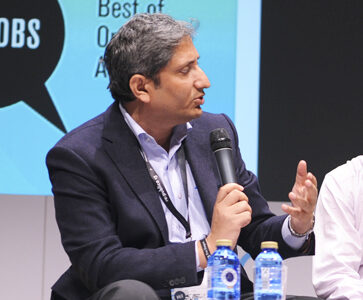
Ravish Kumar is an Indian journalist. Born December 5, 1974, in Motihari. Educated at University of Delhi and Loyola High School, Patna. Awards include Ramon Magsaysay Award.
Facts
15 facts · 1 confirmed by two sources · 4 cited · 10 from one source
Where this comes from
Papalocal keeps its own record. It started from these sources; what each one said is kept here as it was copied, so a change on their side never changes this page by itself. Tap one to read its version.
What Wikidata says · copied November 18, 2026 · revision 2561241635
- Described as
- Indian journalist
- Born
- December 5, 1974
- Born in
- Motihari
- Citizen of
- India
- Occupation
- news presenter; journalist · 1 reference; blogger; editor; writer · 2 references; opinion journalist · 1 reference
- Education
- University of Delhi; Loyola High School, Patna; Deshbandhu College; Indian Institute of Mass Communication
- Awards
- Ramon Magsaysay Award (2019)
- Field
- state · 1 reference
- Wikipedias with a page
- 21
Wikidata item Q7296776 (wikidata.org/wiki/Q7296776), public domain (CC0). Copied November 18, 2026.
What Wikipedia says · copied November 18, 2026 · revision 1379413840
Ravish Kumar (born Ravish Kumar Pandey; 5 December 1974) is an Indian journalist and author. He worked for the Hindi-language television news channel NDTV India from 1994 to 2022, eventually becoming its Senior Executive Editor. He hosted a number of the channel's programmes including its flagship weekday show Prime Time as well as Hum Log, Ravish Ki Report, and Des Ki Baat. In 2022, Kumar resigned from NDTV, following its acquisition by the Adani Group, and started a YouTube channel. Kumar has twice been conferred with Ramnath Goenka Excellence in Journalism Award (in 2013 and 2017) and became the fifth Indian journalist to receive the Ramon Magsaysay Award in 2019.
- Born, in its opening lines
- December 5, 1974
From the Wikipedia article “Ravish Kumar” (en.wikipedia.org/wiki/Ravish_Kumar), by its contributors, under CC BY-SA 4.0 (creativecommons.org/licenses/by-sa/4.0/). Copied November 18, 2026; not changed.
Confirmed Two sources agree. Cited One source, and it names where it got it. One source One source, without a reference of its own. Sources disagree The sources disagree. We show the best-supported value and keep theirs below.
