
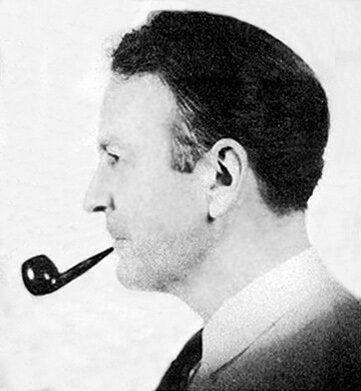
Raymond Chandler
Raymond Chandler was an American novelist and screenwriter. Born July 23, 1888, in Chicago. Died March 26, 1959, in La Jolla. Known for The Big Sleep, Farewell, My Lovely and The High Window. Educated at Dulwich College. Awards include Edgar Allan Poe Award for Best Novel.
Facts
28 facts · 2 confirmed by two sources · 6 cited · 20 from one source
Where this comes from
Papalocal keeps its own record. It started from these sources; what each one said is kept here as it was copied, so a change on their side never changes this page by itself. Tap one to read its version.
What Wikidata says · copied November 13, 2026 · revision 2558221943
- Described as
- American novelist and screenwriter (1888–1959)
- Other names
- Raymond Thornton Chandler
- Born
- July 23, 1888 · 13 references
- Died
- March 26, 1959 · 12 references
- Born in
- Chicago · 2 references
- Died in
- La Jolla · 1 reference
- Buried in
- Mount Hope Cemetery
- Cause of death
- pneumonia
- Name at birth
- Raymond Thornton Chandler
- Citizen of
- United States
- Occupation
- screenwriter · 1 reference; novelist; writer · 2 references; poet · 1 reference; crime fiction writer · 1 reference
- Education
- Dulwich College
- Genre
- detective fiction
- Known for
- The Big Sleep; Farewell, My Lovely; The High Window; The Lady in the Lake; The Little Sister; The Long Goodbye; Playback; Poodle Springs
- Awards
- Edgar Allan Poe Award for Best Novel (1955) · 1 reference
- Field
- crime novel · 1 reference
- Spouse
- Cissy Pascal
- Military branch
- British Army; Royal Air Force
- Wikipedias with a page
- 88
Wikidata item Q180377 (wikidata.org/wiki/Q180377), public domain (CC0). Copied November 13, 2026.
What Wikipedia says · copied November 13, 2026 · revision 1385099055
Raymond Thornton Chandler (July 23, 1888 – March 26, 1959) was an American-British novelist and screenwriter. In 1932, at age 44, Chandler became a detective fiction writer after losing his job as an oil company executive during the Great Depression. His first short story, "Blackmailers Don't Shoot", was published in 1933 in Black Mask, a pulp magazine. His first novel, The Big Sleep, was published in 1939. In addition to his short stories, Chandler published seven novels during his lifetime (an eighth, in progress at the time of his death, was completed by Robert B. Parker). All but Playback have been made into motion pictures, some more than once.
Chandler had an immense stylistic influence on American popular literature. He is a founder of the hardboiled school of detective fiction, along with Dashiell Hammett, James M. Cain, and other Black Mask writers. The protagonist of his novels, Philip Marlowe, like Hammett's Sam Spade, is considered by some to be synonymous with "private detective". Both were played in films by Humphrey Bogart, whom many consider to be the quintessential Marlowe.
The Big Sleep placed second on the Crime Writers' Association poll of the 100 best crime novels; Farewell, My Lovely (1940), The Lady in the Lake (1943), and The Long Goodbye (1953) also made the list. The latter novel was praised in an anthology of American crime stories as "arguably the first book since Hammett's The Glass Key, published more than twenty years earlier, to qualify as a serious and significant mainstream novel that just happened to possess elements of mystery". Chandler was also a perceptive critic of detective fiction; his "The Simple Art of Murder" is the canonical essay in the field. In it he wrote: "Down these mean streets a man must go who is not himself mean, who is neither tarnished nor afraid. The detective must be a complete man and a common man and yet an unusual man. He must be, to use a rather weathered phrase, a man of honor—by instinct, by inevitability, without thought of it, and certainly without saying it. He must be the best man in his world and a good enough man for any world."
Parker wrote that, with Marlowe, "Chandler seems to have created the culminating American hero: wised up, hopeful, thoughtful, adventurous, sentimental, cynical, and rebellious—an innocent who knows better, a Romantic who is tough enough to sustain Romanticism in a world that has seen the eternal footman hold its coat and snicker. Living at the end of the Far West, where the American dream ran out of room, no hero has ever been more congruent with his landscape. Chandler had the right hero in the right place, and engaged him in the consideration of good and evil at precisely the time when our central certainty of good no longer held."
- Born, in its opening lines
- July 23, 1888
- Died, in its opening lines
- March 26, 1959
From the Wikipedia article “Raymond Chandler” (en.wikipedia.org/wiki/Raymond_Chandler), by its contributors, under CC BY-SA 4.0 (creativecommons.org/licenses/by-sa/4.0/). Copied November 13, 2026; not changed.
Confirmed Two sources agree. Cited One source, and it names where it got it. One source One source, without a reference of its own. Sources disagree The sources disagree. We show the best-supported value and keep theirs below.
