
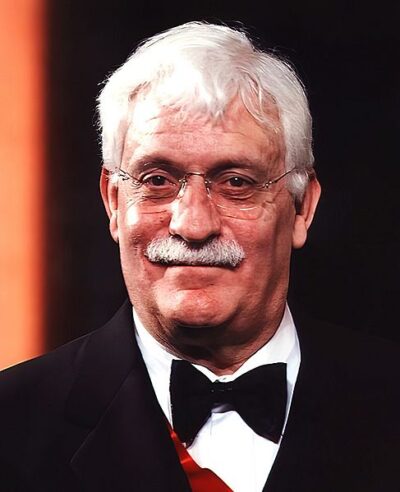
Raymond Vahan Damadian
Raymond Vahan Damadian was an American scientist and inventor. Born March 16, 1936, in New York City. Died August 3, 2022, in Woodbury. Known for magnetic resonance imaging. Educated at Juilliard School and University of Wisconsin–Madison. Awards include National Medal of Technology and Innovation, National Inventors Hall of Fame and Lemelson–MIT Prize.
Facts
21 facts · 2 confirmed by two sources · 6 cited · 13 from one source
Where this comes from
Papalocal keeps its own record. It started from these sources; what each one said is kept here as it was copied, so a change on their side never changes this page by itself. Tap one to read its version.
What Wikidata says · copied November 15, 2026 · revision 2567632318
- Described as
- American scientist and inventor (1936–2022)
- Other names
- Raymond Damadian
- Born
- March 16, 1936 · 3 references
- Died
- August 3, 2022 · 3 references
- Born in
- New York City · 1 reference
- Died in
- Woodbury
- Buried in
- Pinelawn Memorial Park · 1 reference
- Citizen of
- United States; France
- Occupation
- physician; entrepreneur; physicist; inventor; biophysicist · 2 references
- Education
- Juilliard School; University of Wisconsin–Madison; Albert Einstein College of Medicine
- Known for
- magnetic resonance imaging
- Awards
- National Medal of Technology and Innovation (1988) · 1 reference; National Inventors Hall of Fame (1989) · 1 reference; Lemelson–MIT Prize (2001); Bower Award for Business Leadership (2004) · 2 references
- Field
- medical physics
- Wikipedias with a page
- 33
Wikidata item Q983493 (wikidata.org/wiki/Q983493), public domain (CC0). Copied November 15, 2026.
What Wikipedia says · copied November 15, 2026 · revision 1384238708
Raymond Vahan Damadian (Armenian: Ռեյմոնդ Վահան Դամադյան; March 16, 1936 – August 3, 2022) was an American physician, medical researcher, and inventor of the first nuclear magnetic resonance (NMR) scanning machine.
Damadian's research into sodium and potassium in living cells led him to his first experiments with nuclear magnetic resonance (NMR) which caused him to first propose the MR body scanner in 1969. Damadian discovered that tumors and normal tissue can be distinguished in vivo by nuclear magnetic resonance (NMR) because of their prolonged relaxation times, both T1 (spin-lattice relaxation) or T2 (spin-spin relaxation). Damadian was the first to perform a full-body scan of a human being in 1977 to diagnose cancer. Damadian invented an apparatus and method to use NMR safely and accurately to scan the human body, a method now well known as magnetic resonance imaging (MRI).
Damadian received several prizes. In 2001, the Lemelson–MIT Prize Program bestowed its $100,000 Lifetime Achievement Award on Damadian as "the man who invented the MRI scanner." He went on to collaborate with Wilson Greatbach, one early developer of the implantable pacemaker, to develop an MRI-compatible pacemaker. The Franklin Institute in Philadelphia gave its recognition of Damadian's work on MRI with the Bower Award in Business Leadership. He was also named Knights of Vartan 2003 "Man of the Year". He received a National Medal of Technology in 1988 and was inducted into the National Inventors Hall of Fame in 1989.
- Born, in its opening lines
- March 16, 1936
- Died, in its opening lines
- August 3, 2022
From the Wikipedia article “Raymond Damadian” (en.wikipedia.org/wiki/Raymond_Damadian), by its contributors, under CC BY-SA 4.0 (creativecommons.org/licenses/by-sa/4.0/). Copied November 15, 2026; not changed.
Confirmed Two sources agree. Cited One source, and it names where it got it. One source One source, without a reference of its own. Sources disagree The sources disagree. We show the best-supported value and keep theirs below.
