
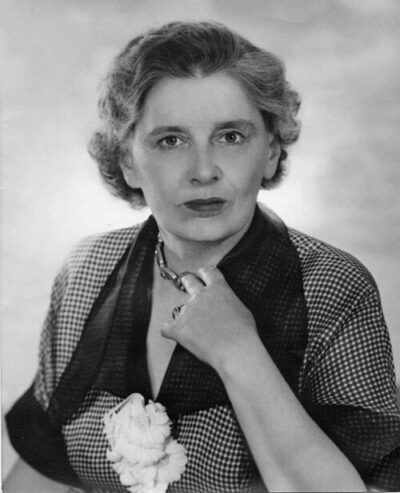
Rebecca West
Rebecca West was a British writer, journalist, literary critic, and feminist. Born December 21, 1892, in London. Died March 15, 1983, in London. Positions held include Booker Prize judge (1969). Educated at George Watson's College. Awards include Dame Commander of the Order of the British Empire and Fellow of the American Academy of Arts and Sciences.
Facts
30 facts · 2 confirmed by two sources · 15 cited · 13 from one source
Where this comes from
Papalocal keeps its own record. It started from these sources; what each one said is kept here as it was copied, so a change on their side never changes this page by itself. Tap one to read its version.
What Wikidata says · copied November 16, 2026 · revision 2565546106
- Described as
- British writer, journalist, literary critic, and feminist (1892-1983)
- Other names
- Cicely Isabel Fairfield, Cicely Fairchild, Cicily Isabel Andrews, Cicily Fairfield Andrews, West, Dame Rebecca, Cicily Fairfield, Cicily Isabel Fairfield, Cicily Farifield, Cicily Isobel Fairfield, Dame Cicely Isabel Fairfield, Mrs H. M. Andrews, Cicily Andrews
- Born
- December 21, 1892 · 11 references
- Died
- March 15, 1983 · 12 references
- Born in
- London · 2 references
- Died in
- London · 2 references
- Buried in
- Brookwood Cemetery · 1 reference
- Name at birth
- Cecily Isabel Fairfield · 1 reference
- Citizen of
- United Kingdom
- Occupation
- journalist · 1 reference; writer; literary critic; essayist; suffragette; prose writer · 1 reference; opinion journalist · 1 reference; novelist
- Positions held
- Booker Prize judge (1969) · 1 reference
- Education
- George Watson's College
- Member of
- American Academy of Arts and Sciences
- Awards
- Dame Commander of the Order of the British Empire; Fellow of the American Academy of Arts and Sciences
- Field
- essay; literary activity · 1 reference; literary criticism · 1 reference; travel book · 1 reference; feminism
- Spouse
- Henry Maxwell Andrews (1930–1968)
- Children
- Anthony West · 1 reference
- Father
- Charles Fairfield · 1 reference
- Mother
- Isabella Campbell Mackenzie · 1 reference
- Siblings
- Letitia Fairfield · 1 reference
- Wikipedias with a page
- 58
Wikidata item Q236669 (wikidata.org/wiki/Q236669), public domain (CC0). Copied November 16, 2026.
What Wikipedia says · copied November 16, 2026 · revision 1383922757
Dame Cecily Isabel Fairfield (21 December 1892 – 15 March 1983), known as Rebecca West, or Dame Rebecca West, was a British author, journalist, literary critic and travel writer. An author who wrote in many genres, West reviewed books for The Times, the New York Herald Tribune, The Sunday Telegraph and The New Republic, and she was a correspondent for The Bookman.
Her major works include Black Lamb and Grey Falcon (1941), on the history and culture of Yugoslavia; A Train of Powder (1955), her coverage of the Nuremberg trials, published originally in The New Yorker; The Meaning of Treason (first published as a magazine article in 1945 and then expanded to the book in 1947), later The New Meaning of Treason (1964), a study of the trial of American-born fascist William Joyce and others; The Return of the Soldier (1918), a modernist World War I novel; and the "Aubrey trilogy" of autobiographical novels, The Fountain Overflows (1956), This Real Night (published posthumously in 1984), and Cousin Rosamund (1985).
Time called her "indisputably the world's number one woman writer" in 1947. She was made CBE in 1949, and DBE in 1959; in each case, the citation reads: "writer and literary critic". She took the pseudonym "Rebecca West" from the rebellious young heroine in Rosmersholm by Henrik Ibsen. She was a recipient of the Benson Medal in 1966.
- Born, in its opening lines
- December 21, 1892
- Died, in its opening lines
- March 15, 1983
From the Wikipedia article “Rebecca West” (en.wikipedia.org/wiki/Rebecca_West), by its contributors, under CC BY-SA 4.0 (creativecommons.org/licenses/by-sa/4.0/). Copied November 16, 2026; not changed.
Confirmed Two sources agree. Cited One source, and it names where it got it. One source One source, without a reference of its own. Sources disagree The sources disagree. We show the best-supported value and keep theirs below.
