
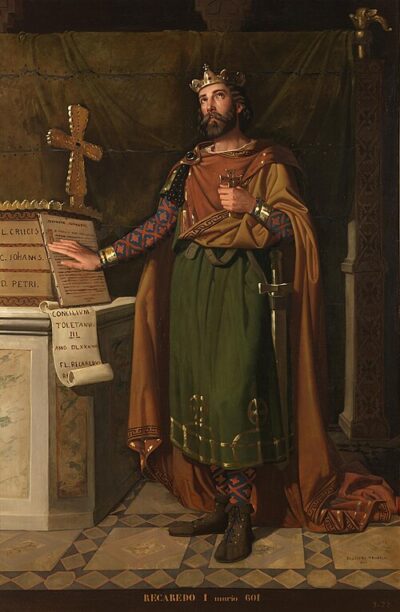
Reccared I
Reccared I was a Visigothic King. Born 560s, in Seville. Died December 601, in Toledo. Positions held include king of Wisigoths (586–601).
Facts
14 facts · 1 confirmed by two sources · 3 cited · 9 from one source · 1 where the sources disagree
What’s different
- Born: we show 560s (Sources disagree). Wikipedia says c. 559
Where this comes from
Papalocal keeps its own record. It started from these sources; what each one said is kept here as it was copied, so a change on their side never changes this page by itself. Tap one to read its version.
What Wikidata says · copied November 16, 2026 · revision 2565663196
- Described as
- Visigothic King
- Other names
- Recaredo, Rekkared
- Born
- 560s · 1 reference
- Died
- December 601 · 1 reference
- Born in
- Seville · 1 reference
- Died in
- Toledo
- Citizen of
- Visigothic Kingdom
- Occupation
- sovereign
- Positions held
- king of Wisigoths (586–601)
- Field
- nobility · 1 reference; history · 1 reference
- Spouse
- Baddo
- Children
- Liuva II
- Father
- Liuvigild
- Siblings
- Hermenegild
- Religion
- Catholicism
- Wikipedias with a page
- 40
Wikidata item Q313057 (wikidata.org/wiki/Q313057), public domain (CC0). Copied November 16, 2026.
What Wikipedia says · copied November 16, 2026 · revision 1383949007
Reccared I (or Recared; Latin: Flavius Reccaredus; Spanish: Flavio Recaredo; c. 559 – December 601; reigned 586–601) was the king of the Visigoths, ruling in Hispania, Gallaecia and Septimania. His reign marked a climactic shift in history, with the king's renunciation of Arianism in favour of Catholic Christianity in 587.
- Born, in its opening lines
- c. 559
- Died, in its opening lines
- December 601
From the Wikipedia article “Reccared I” (en.wikipedia.org/wiki/Reccared_I), by its contributors, under CC BY-SA 4.0 (creativecommons.org/licenses/by-sa/4.0/). Copied November 16, 2026; not changed.
Confirmed Two sources agree. Cited One source, and it names where it got it. One source One source, without a reference of its own. Sources disagree The sources disagree. We show the best-supported value and keep theirs below.
