
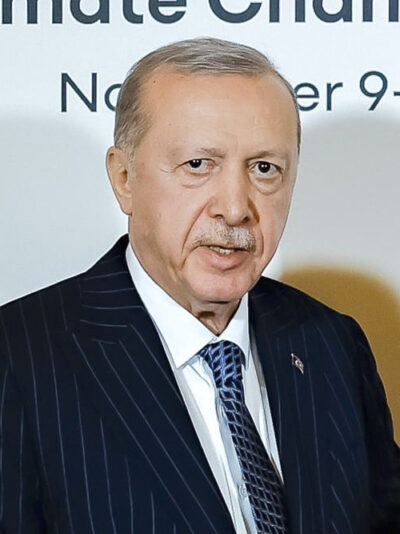
Recep Tayyip Erdoğan
Recep Tayyip Erdoğan is a President of Turkey since 2014. Born February 26, 1954, in Istanbul. Positions held include President of Turkey (2014–), Prime Minister of Turkey (2003–2014) and member of the Grand National Assembly of Turkey (2003–2014). Known for A Fairer World Is Possible. Educated at Marmara University and İmam Hatip school. Awards include Order of the Golden Fleece, Nishan-e-Pakistan and Order of the Golden Eagle.

Facts
46 facts · 1 confirmed by two sources · 5 cited · 40 from one source
Where this comes from
Papalocal keeps its own record. It started from these sources; what each one said is kept here as it was copied, so a change on their side never changes this page by itself. Tap one to read its version.
What Wikidata says · copied November 16, 2026 · revision 2568706409
- Described as
- President of Turkey since 2014
- Other names
- Erdoğan, Recep Tayyip Erdogan, Recep Erdogan, Erdogan, Tayyip Erdogan, Tayyip Erdoğan
- Born
- February 26, 1954 · 3 references
- Born in
- Istanbul · 1 reference
- Citizen of
- Turkey
- Occupation
- statesperson; politician · 2 references; party leader · 1 reference
- Positions held
- President of Turkey (2014–); Prime Minister of Turkey (2003–2014); member of the Grand National Assembly of Turkey (2003–2014); mayor of Istanbul (1994–1998); president · 1 reference
- Political party
- National Salvation Party (–1980); Welfare Party (1983–1997); Virtue Party (1997–1998); Justice and Development Party (2001–)
- Education
- Marmara University (–1981); İmam Hatip school
- Teams
- Kasımpaşa S.K. (1954–)
- Known for
- A Fairer World Is Possible
- Awards
- Order of the Golden Fleece (2010); Nishan-e-Pakistan (2009); Order of the Golden Eagle; Order "Danaker" (2011); Heydar Aliyev Order; Al-Gaddafi International Prize for Human Rights; Steiger Award; King Faisal Prize in Service to Islam (2010); Golden Plate Award (2004); Grand Cross of the National Order of Merit (Guinea) · 1 reference; National Order of Madagascar (2017); Order of Mubarak the Great; Medal "In Commemoration of the 1000th Anniversary of Kazan"; Order of the Somali Star · 1 reference; Order of the Republic (2018) · 1 reference
- Field
- politics
- Spouse
- Emine Erdoğan (1978–)
- Children
- Sümeyye Erdoğan; Bilal Erdoğan; Ahmet Burak Erdoğan; Esra Albayrak Erdoğan
- Father
- Ahmet Erdoğan 1903-1988
- Mother
- Tenzile Erdoğan
- Religion
- Sunni Islam
- Lived in
- Istanbul
- Height
- 1.85 m (6 ft 1 in) · 1 reference
- Website
- https://www.tccb.gov.tr
- Wikipedias with a page
- 186
Wikidata item Q39259 (wikidata.org/wiki/Q39259), public domain (CC0). Copied November 16, 2026.
What Wikipedia says · copied November 16, 2026 · revision 1385801776
Recep Tayyip Erdoğan (born 26 February 1954) is a Turkish politician who has been the president of Turkey since 2014. He previously served as the 25th prime minister from 2003 to 2014 as part of the Justice and Development Party (AKP), which he co-founded in 2001. He also served as mayor of Istanbul from 1994 to 1998. Coming from an Islamist background and promoting socially conservative policies, Erdoğan has been Turkey's de facto leader since 2003. Turkey has experienced democratic backsliding and suppression of dissent under Erdoğan.
Erdoğan was born in Beyoğlu, Istanbul, and studied at the Aksaray Academy of Economic and Commercial Sciences, before working as a consultant and senior manager in the private sector. Becoming active in local politics, he was elected Welfare Party's Beyoğlu district chair in 1984 and Istanbul chair in 1985. Following the 1994 local elections, Erdoğan was elected mayor of Istanbul. In 1998 he was convicted for inciting religious hatred and banned from politics after reciting a poem by Ziya Gökalp that compared mosques to barracks and the faithful to an army. Erdoğan was released from prison in 1999 and formed the AKP, abandoning openly Islamist policies.
Erdoğan led the AKP to a landslide victory in the election for the Grand National Assembly in 2002, and became prime minister after winning a by-election in Siirt in 2003. Erdoğan led the AKP to two more election victories in 2007 and 2011. His tenure consisted of economic recovery from the economic crisis of 2001, the start of EU membership negotiations, and the reduction of military influence on politics. In late 2012, his government began peace negotiations with the Kurdistan Workers Party (PKK) to end the Kurdish–Turkish conflict, negotiations which ended three years later.
In 2014, Erdoğan became the country's first directly elected president. Erdoğan's presidency has been marked by democratic backsliding and a shift towards authoritarianism. His economic policies have led to high inflation and the depreciation of the Turkish lira. He has intervened in conflicts in Syria and Libya, launched operations against the Islamic State, Syrian Democratic Forces, and Ba'athist Syria, and has made threats against Greece and Israel. He oversaw the transformation of Turkey's parliamentary system into a presidential system, introducing term limits and expanding executive powers, and Turkey's migrant crisis. In May 2022, Erdoğan temporarily blocked Finland and Sweden from joining NATO. Erdoğan responded to the 2022 Russian invasion of Ukraine by closing the Bosphorus to Russian naval reinforcements, brokering a deal between Russia and Ukraine regarding the export of grain, and mediating a prisoner exchange. In 2025, Erdoğan oversaw the arrest of Istanbul mayor Ekrem İmamoğlu and his subsequent disqualification from the upcoming 2028 presidential election, for which he was considered the opposition front-runner, leading to ongoing widespread protests.
- Born, in its opening lines
- February 26, 1954
From the Wikipedia article “Recep Tayyip Erdoğan” (en.wikipedia.org/wiki/Recep_Tayyip_Erdoğan), by its contributors, under CC BY-SA 4.0 (creativecommons.org/licenses/by-sa/4.0/). Copied November 16, 2026; not changed.
Confirmed Two sources agree. Cited One source, and it names where it got it. One source One source, without a reference of its own. Sources disagree The sources disagree. We show the best-supported value and keep theirs below.
