
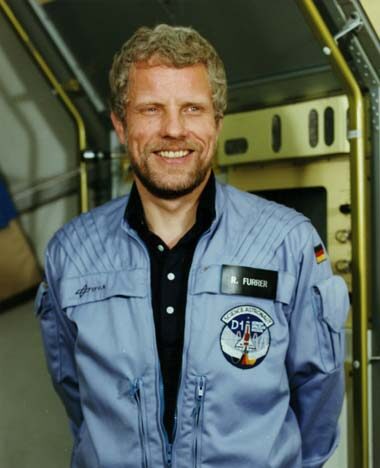
Reinhard Furrer
Reinhard Furrer was a German astronaut. Born November 25, 1940, in Wörgl. Died September 9, 1995, in Berlin. Educated at Freie Universität Berlin.
Facts
13 facts · 2 confirmed by two sources · 1 cited · 10 from one source
Where this comes from
Papalocal keeps its own record. It started from these sources; what each one said is kept here as it was copied, so a change on their side never changes this page by itself. Tap one to read its version.
What Wikidata says · copied November 18, 2026 · revision 2568795213
- Described as
- German astronaut (1940-1995)
- Born
- November 25, 1940 · 1 reference
- Died
- September 9, 1995 · 2 references
- Born in
- Wörgl
- Died in
- Berlin
- Buried in
- Kempten Lutheran cemetery
- Cause of death
- aircraft crash
- Citizen of
- Germany
- Occupation
- astronaut; physicist; aircraft pilot · 1 reference; university teacher · 1 reference
- Education
- Freie Universität Berlin
- Member of
- German astronaut team
- Wikipedias with a page
- 20
Wikidata item Q215131 (wikidata.org/wiki/Q215131), public domain (CC0). Copied November 18, 2026.
What Wikipedia says · copied November 18, 2026 · revision 1378504429
Reinhard Alfred Furrer (25 November 1940 – 9 September 1995) was a German physicist and astronaut.
Furrer was born in Wörgl, Ostmark (now Austria). After the end of World War II, his father was expelled from Austria. The family found a new home in Kempten im Allgäu, Bavaria. Furrer stayed there until he joined the University of Kiel to study physics. He later transferred to the Free University of Berlin, where he received a diploma in 1969, and a doctorate in 1972. During his time as a student in Berlin, he was involved in the building of the 145-metre-long (476 ft) "Tunnel 57" below the Berlin Wall, which was the escape route of 57 people from East Berlin to the West.
In 1974 he became assistant professor in Stuttgart and in 1979 qualified for full professorship. He spent time during 1980–1981 at the University of Chicago and during 1981 at the Argonne National Laboratory in Chicago, US.
In 1977 Furrer applied for selection as an astronaut for the first Spacelab mission. He made it into the final round of candidates, although Ulf Merbold was finally selected. In 1982, the astronauts for the first German Spacelab mission were selected from the finalists for the first mission, and Furrer was one of the two chosen. He was a payload specialist on STS-61-A (D1), which was launched on 30 October 1985. The other payload specialists on the flight were Ernst Messerschmid and Wubbo Ockels (Netherlands).
Furrer wore the Sinn (watchmaker) model 140 S on his wrist during the STS-61-A mission in 1985.
After his spaceflight he became a professor in 1987 as well as the director of the Institute of Space Sciences at the Free University of Berlin.
Furrer was an avid pilot. He earned his pilot license in 1974, doing several long-distance trips with one-engine planes - including a flight over the inland ice of Greenland in 1979 and a solo flight from Germany to Quito, Ecuador in 1981. His love for planes finally cost him his life, as he died in a plane crash after a flight show on the Johannisthal Air Field (Berlin). He was a passenger of pilot Gerd Kahdemann in a historic Bf 108 when the plane crashed shortly after 6:00 p.m. after performing a roll at low altitude. Both Kahdemann and Furrer were killed instantly.
- Born, in its opening lines
- November 25, 1940
- Died, in its opening lines
- September 9, 1995
From the Wikipedia article “Reinhard Furrer” (en.wikipedia.org/wiki/Reinhard_Furrer), by its contributors, under CC BY-SA 4.0 (creativecommons.org/licenses/by-sa/4.0/). Copied November 18, 2026; not changed.
Confirmed Two sources agree. Cited One source, and it names where it got it. One source One source, without a reference of its own. Sources disagree The sources disagree. We show the best-supported value and keep theirs below.
