
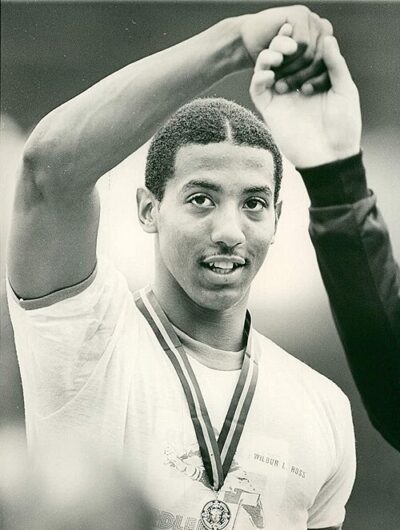
Renaldo Nehemiah is a hurdler, American football player. Born March 24, 1959, in Newark. Teams include San Francisco 49ers. Educated at Scotch Plains-Fanwood High School and University of Maryland.
Facts
11 facts · 1 confirmed by two sources · 2 cited · 8 from one source
Where this comes from
Papalocal keeps its own record. It started from these sources; what each one said is kept here as it was copied, so a change on their side never changes this page by itself. Tap one to read its version.
What Wikidata says · copied November 18, 2026 · revision 2564939280
- Described as
- hurdler, American football player
- Born
- March 24, 1959 · 1 reference
- Born in
- Newark
- Citizen of
- United States
- Occupation
- athletics competitor; American football player
- Education
- Scotch Plains-Fanwood High School · 1 reference; University of Maryland · 1 reference
- Teams
- San Francisco 49ers
- Sport
- American football · 1 reference; athletics
- Height
- 1.85 m (6 ft 1 in)
- Wikipedias with a page
- 15
Wikidata item Q954108 (wikidata.org/wiki/Q954108), public domain (CC0). Copied November 18, 2026.
What Wikipedia says · copied November 18, 2026 · revision 1383842560
Renaldo Nehemiah (born March 24, 1959) is a retired American track and field athlete who specialized in the 110 m hurdles. He was ranked number one in the world for four straight years, and is a former world record holder. Nehemiah is the first man to run the event in under 13 seconds. Nehemiah also played pro football in the National Football League (NFL) as a wide receiver for the San Francisco 49ers from 1982 to 1985, before returning to track and field athletics from 1986 to 1991. After retiring from competition, he has worked in sports management.
- Born, in its opening lines
- March 24, 1959
From the Wikipedia article “Renaldo Nehemiah” (en.wikipedia.org/wiki/Renaldo_Nehemiah), by its contributors, under CC BY-SA 4.0 (creativecommons.org/licenses/by-sa/4.0/). Copied November 18, 2026; not changed.
Confirmed Two sources agree. Cited One source, and it names where it got it. One source One source, without a reference of its own. Sources disagree The sources disagree. We show the best-supported value and keep theirs below.
