
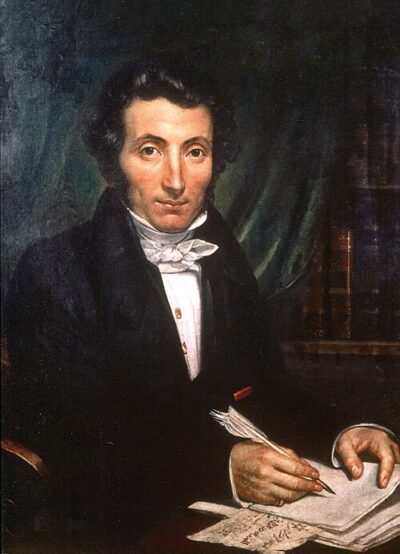
René Caillié
René Caillié was a French explorer. Born November 19, 1799, in Mauzé-sur-le-Mignon. Died May 17, 1838, in La Gripperie-Saint-Symphorien. Awards include Grande Médaille d'Or des Explorations.
Facts
13 facts · 2 confirmed by two sources · 5 cited · 6 from one source
Where this comes from
Papalocal keeps its own record. It started from these sources; what each one said is kept here as it was copied, so a change on their side never changes this page by itself. Tap one to read its version.
What Wikidata says · copied November 16, 2026 · revision 2559112729
- Described as
- French explorer (1799–1838)
- Other names
- Rene Caillie, René-Auguste Caillié
- Born
- November 19, 1799 · 2 references
- Died
- May 17, 1838 · 4 references
- Born in
- Mauzé-sur-le-Mignon · 1 reference
- Died in
- La Gripperie-Saint-Symphorien
- Cause of death
- tuberculosis
- Citizen of
- France · 1 reference
- Occupation
- explorer; traveler · 1 reference; travel writer · 1 reference
- Awards
- Grande Médaille d'Or des Explorations (1830)
- Field
- European exploration of Africa · 1 reference
- Religion
- Christianity
- Lived in
- Rene Caille House (1828)
- Wikipedias with a page
- 28
Wikidata item Q368976 (wikidata.org/wiki/Q368976), public domain (CC0). Copied November 16, 2026.
What Wikipedia says · copied November 16, 2026 · revision 1382431157
Auguste René Caillié (French pronunciation: [ʁəne kaje]; 19 November 1799 – 17 May 1838) was a French explorer and the first European to return alive from the town of Timbuktu. Caillié had been preceded at Timbuktu by a British officer, Major Gordon Laing, who was murdered in September 1826 on leaving the city. Caillié was therefore the first to return alive.
Caillié was born in western France in a village near the port of Rochefort. His parents were poor and died while he was still young. At the age of 16 he left home and signed up as a member of the crew on a French naval vessel sailing to Saint-Louis on the coast of modern Senegal in western Africa. He stayed there for several months and then crossed the Atlantic to Guadeloupe on a merchantman. He made a second visit to West Africa two years later when he accompanied a British expedition across the Ferlo Desert to Bakel on the Senegal River.
Caillié returned to Saint-Louis in 1824 with a strong desire to become an explorer and visit Timbuktu. In order to avoid some of the difficulties experienced by the earlier expeditions, he planned to travel alone disguised as a Muslim. He persuaded the French governor in Saint-Louis to help finance a stay of 8 months with the nomadic people in the Brakna Region of southern Mauritania where he learned Arabic and the customs of Islam. He failed to obtain further funding from either the French or the British governments, but encouraged by the prize of 9,000 francs offered by the Société de Géographie in Paris for the first person to return with a description of Timbuktu, he decided to fund the journey himself. He worked for a few months in the British colony of Sierra Leone to save some money, then travelled by ship to Boké on the Rio Nuñez in modern Guinea. From there in April 1827 he set off across West Africa. He arrived in Timbuktu a year later and stayed there for two weeks before heading across the Sahara Desert to Tangier in Morocco.
On his return to France, he was awarded the prize of 9,000 francs by the Société de Géographie and, helped by the scholar Edme-François Jomard, published an account of his journey. In 1830, he was awarded the Gold Medal by the Société de Géographie.
Caillié married and settled near his birthplace. He suffered from poor health and died of tuberculosis aged 38.
- Born, in its opening lines
- November 19, 1799
- Died, in its opening lines
- May 17, 1838
From the Wikipedia article “René Caillié” (en.wikipedia.org/wiki/René_Caillié), by its contributors, under CC BY-SA 4.0 (creativecommons.org/licenses/by-sa/4.0/). Copied November 16, 2026; not changed.
Confirmed Two sources agree. Cited One source, and it names where it got it. One source One source, without a reference of its own. Sources disagree The sources disagree. We show the best-supported value and keep theirs below.
