
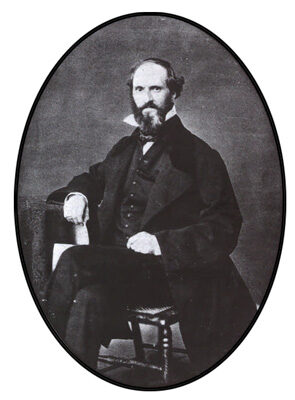
Richard Spruce
Richard Spruce was a British botanist and explorer. Born September 10, 1817, in Ganthorpe. Died December 28, 1893, in Coneysthorpe.
Facts
17 facts · 2 confirmed by two sources · 6 cited · 9 from one source
Where this comes from
Papalocal keeps its own record. It started from these sources; what each one said is kept here as it was copied, so a change on their side never changes this page by itself. Tap one to read its version.
What Wikidata says · copied November 18, 2026 · revision 2563228516
- Described as
- British botanist and explorer (1817–1893)
- Other names
- Spruce, R. Spruce
- Born
- September 10, 1817 · 2 references
- Died
- December 28, 1893 · 2 references
- Born in
- Ganthorpe
- Died in
- Coneysthorpe
- Buried in
- Terrington
- Citizen of
- United Kingdom of Great Britain and Ireland
- Occupation
- botanist · 1 reference; explorer; entomologist; pteridologist; bryologist; naturalist; botanical collector · 6 references; scientific collector · 1 reference
- Field
- botany · 1 reference; bryology · 1 reference; systematic botany · 1 reference
- Wikipedias with a page
- 20
Wikidata item Q1349394 (wikidata.org/wiki/Q1349394), public domain (CC0). Copied November 18, 2026.
What Wikipedia says · copied November 18, 2026 · revision 1381028528
Richard Spruce (10 September 1817 – 28 December 1893) was an English botanist specializing in bryology. One of the great Victorian botanical explorers, Spruce spent 15 years exploring the Amazon from the Andes to its mouth, and was one of the very first Europeans to observe many of the places where he collected specimens. Spruce discovered and named a number of new plant species, and corresponded with some of the leading botanists of the nineteenth century.
- Born, in its opening lines
- September 10, 1817
- Died, in its opening lines
- December 28, 1893
From the Wikipedia article “Richard Spruce” (en.wikipedia.org/wiki/Richard_Spruce), by its contributors, under CC BY-SA 4.0 (creativecommons.org/licenses/by-sa/4.0/). Copied November 18, 2026; not changed.
Confirmed Two sources agree. Cited One source, and it names where it got it. One source One source, without a reference of its own. Sources disagree The sources disagree. We show the best-supported value and keep theirs below.
