
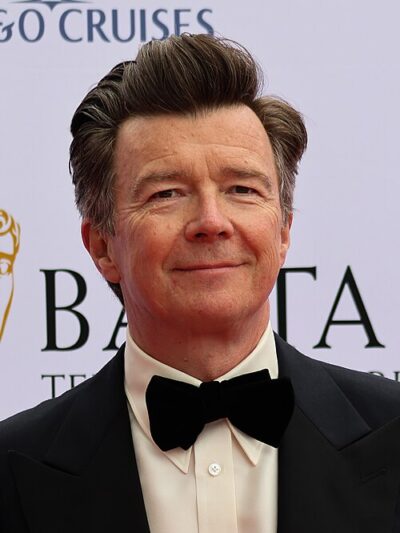
Rick Astley
Rick Astley is a British singer. Born February 6, 1966, in Newton-le-Willows. Known for Never Gonna Give You Up, Whenever You Need Somebody and Are We There Yet?.
Facts
25 facts · 1 confirmed by two sources · 3 cited · 21 from one source
Where this comes from
Papalocal keeps its own record. It started from these sources; what each one said is kept here as it was copied, so a change on their side never changes this page by itself. Tap one to read its version.
What Wikidata says · copied November 16, 2026 · revision 2564538143
- Described as
- British singer
- Other names
- Richard Paul Astley, Richard Astley, Rick Paul Astley, Richard P. Astley, Rick P. Astley
- Born
- February 6, 1966 · 2 references
- Born in
- Newton-le-Willows · 1 reference
- Citizen of
- United Kingdom
- Occupation
- singer-songwriter; radio personality; musician · 1 reference; singer
- Genre
- blue-eyed soul; dance music; dance-pop · 1 reference; disco · 1 reference; soul · 1 reference
- Instrument
- guitar; voice
- Record label
- Sony Music; Stock Aitken Waterman · 1 reference; RCA Records · 1 reference; Polydor Records · 1 reference
- Known for
- Never Gonna Give You Up; Whenever You Need Somebody; Are We There Yet?; Beautiful Life
- Spouse
- Lene Bausager (2003–)
- Lived in
- East Molesey · 1 reference
- Website
- https://www.rickastley.co.uk
- Wikipedias with a page
- 63
Wikidata item Q219237 (wikidata.org/wiki/Q219237), public domain (CC0). Copied November 16, 2026.
What Wikipedia says · copied November 16, 2026 · revision 1383676636
Richard Paul Astley (born 6 February 1966) is an English singer, songwriter, radio DJ and podcaster. He gained fame through his association with the production trio Stock Aitken Waterman, releasing the 1987 album Whenever You Need Somebody, which sold 15 million copies worldwide and was certified platinum by both the BPI and the RIAA. His debut single "Never Gonna Give You Up" was a No. 1 hit in more than 25 countries, winning the 1988 Brit Award for Best British Single. The song also stayed at the top of the UK chart for five weeks in 1987 and was the best-selling single of that year. His 1988 single "Together Forever" also topped the US Billboard Hot 100 and was one of his eight songs to reach the UK Singles Chart top 10.
In 1988, Astley followed up his debut album with Hold Me in Your Arms which achieved platinum and gold certifications internationally. The lead single "She Wants to Dance with Me" became a worldwide top 10 hit. In 1991, he left Stock Aitken Waterman and moved his musical direction towards soul, which he explored on his other albums. His 1991 single "Cry for Help" was his last single to reach the top 10 in either the US or UK. In 1993, he retired from music to focus on spending time with his partner and daughter. He returned to the music industry in 2000 and released 50 to celebrate his 50th birthday in 2016, with the album debuting in the UK at No. 1. His most recent studio album Are We There Yet? was released in 2023.
Astley has sold approximately 40 million records worldwide and was nominated in 1989 for a Grammy Award for Best New Artist but lost to Tracy Chapman. During the period between his debut release and his fifth single, Astley outsold every other artist in the world. In the United Kingdom, Astley was also in the top 40 every week for the first six months of his career. He became an internet phenomenon in 2007 following the emergence of the Rickrolling meme, which utilizes the music video for "Never Gonna Give You Up", and his career was revitalised by the meme's popularity. A year after the Rickrolling meme began, he was voted "Best Act Ever" at the MTV Europe Music Awards 2008. On 28 July 2021, "Never Gonna Give You Up" became the fourth 1980s song to reach one billion views on YouTube.
- Born, in its opening lines
- February 6, 1966
From the Wikipedia article “Rick Astley” (en.wikipedia.org/wiki/Rick_Astley), by its contributors, under CC BY-SA 4.0 (creativecommons.org/licenses/by-sa/4.0/). Copied November 16, 2026; not changed.
Confirmed Two sources agree. Cited One source, and it names where it got it. One source One source, without a reference of its own. Sources disagree The sources disagree. We show the best-supported value and keep theirs below.
